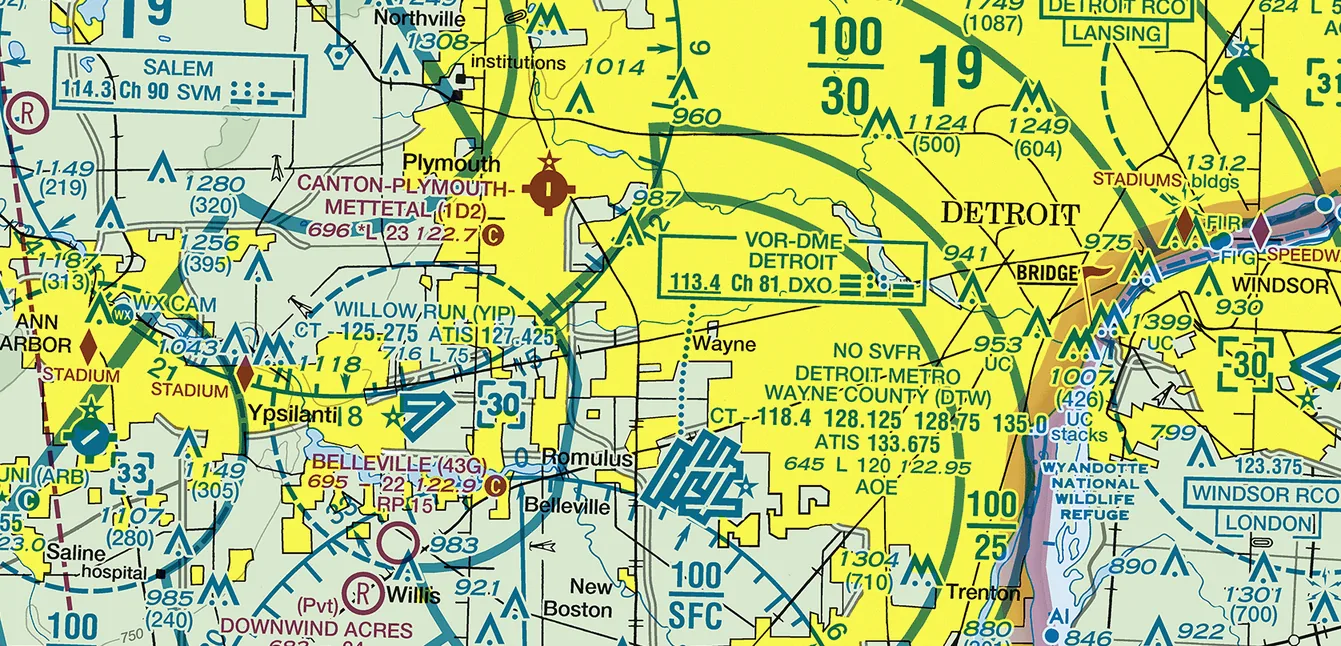
FAA Detroit sectional, 29 OCT 2026 edition. For briefing, not for navigation: fly from the current chart. Tap the chart to open it full size.
Today's flight
Someday a friend will ask to see downtown Detroit and the riverfront from the air. From KARB the straight line to downtown crosses the Class B surface area around Detroit Metro, and going around it under the shelves means a long detour, low over a busy city, with little room between the obstacles below and the Class B floor above. Read both from the current chart and see for yourself. With a clearance, Detroit Approach can take you through.
Today you plan that trip for the day you can bring them, and I play the friend. You ask for the clearance and fly it, out to the river and back. It is a dual flight: the instructor is pilot in command, so the Class B rules for student pilots are met, and you do the talking. You also plan a version of the trip that works if the clearance never comes, because sometimes it doesn't.
Every flight
Before every flight
P
Pilot.Am I fit to fly today? IMSAFE:
Illness
Medication
Stress
Alcohol
Fatigue
Emotion, and eating
A
Aircraft.Is this airplane ready, and right for today? Documents, inspections and open squawks; fuel and oil on board; weight, balance and performance for today's load.
V
Environment.What will today's flight meet? NWKRAFT, what 14 CFR 91.103 asks you to know before every flight, then the airspace and the route:
NOTAMs and TFRs
Weather, against your minimums
Known ATC delays
Runway lengths
Alternates
Fuel required, with reserve
Takeoff and landing distances
Airspace: the Class B limits from the current chart
The trip: heading, time, landmarks, wind and runway
E
External pressures.What is pushing me to go today: a passenger, a schedule, a plan I don't want to cancel? Would I go without it?
If it goes wrong.The takeoff emergency brief, out loud: an engine problem on the runway, after liftoff with runway left, and after liftoff without.
Who flies.Who does what today, and how we hand the controls back and forth.
Who runs it today:You, unprompted, and you brief the instructor.
Deeper today:Airspace and The trip. The limits block covers two plans: plan A through the Class B, with the edge where you will call and the point where you must be cleared or turn away; plan B outside it, with a maximum altitude under each shelf you cross, all from the current chart. The navigation log has both, and Aircraft checks the equipment the Class B requires (a transponder with altitude reporting and ADS-B Out).
Recall
From earlier lessons
You realize you are inside the Class B without a clearance. What do you do?
Reveal answer
Get out the shortest way, which may be down rather than sideways, from the chart. Talk to ATC. Then report it.
What keeps you out of the Class B surface area east of KYIP?
Reveal answer
Pattern entries from the west, departing to the west, and a hard turn-back point, all set from the current chart before the flight.
At Lansing, the controller answered "aircraft calling Lansing Approach, standby." Could you enter the Class C?
Reveal answer
No. Without your callsign, two-way contact isn't established. With your callsign and "standby", it is.
How do you reset the heading indicator, and when?
Reveal answer
From the magnetic compass, in steady, level flight at a constant speed, using the deviation card.
WhyThe Class B is where airliners climb and descend, and the controller can only keep you apart from them if they know you are there and have let you in.
Why a clearance is the only way in
No one flies in the Class B without a clearance from ATC first.
Inside, ATC separates you from other traffic. Outside, it is see and avoid.
The airplane needs a two-way radio, a transponder with altitude reporting and ADS-B Out.
Weather: 3 miles visibility and clear of clouds.
WhyThe day you solo near Detroit, you need to know exactly what you may and may not do.
Who may fly in it
The pilot in command needs a private certificate, or a student endorsement for this Class B.
That endorsement takes ground and flight training here, and is good for 90 days.
A few of the busiest airports ban solo students outright. Detroit Metro isn't one today; read the list.
This course keeps your solos outside the Class B. Today is legal because the instructor is pilot in command.
WhyA clear request, made early and outside the edge, is the one most likely to get a yes.
Asking for it
Find Detroit Approach's frequency for this area in the Chart Supplement and on the terminal area chart.
Call well outside the edge, with time to wait for an answer before you reach it.
Who, where, altitude, request: "Class Bravo transition to downtown Detroit and the river, then back to Ann Arbor."
Expect a squawk code first. Read it back, set it, and keep flying your plan outside the edge.
WhyPlenty of things a controller says sound like permission, and only one of them is.
The words that let you in
Listen for "cleared" and "Bravo airspace" together, like "cleared through Bravo airspace".
Not a clearance: a squawk code, "radar contact", a heading, an altitude to maintain.
Read back the clearance with its route and altitude. Not sure? Ask: "Confirm cleared into the Class Bravo?"
"Remain outside Bravo airspace" means exactly that. Stay out and wait.
WhyInside, ATC plans around the heading and altitude you were given, so flying them exactly is part of the deal.
Inside and out again
Fly the assigned heading and altitude, and check the heading against the compass. Downtown is a distraction.
You are still VFR: clear of clouds, see and avoid, and wake turbulence behind airliners.
If an instruction would break a rule or put you in a cloud, say "unable" and why.
Leaving: listen for "resume own navigation" and "resume appropriate VFR altitudes".
WhyThe Detroit River is the border with Canada, and an airplane that strays or doesn't answer the radio can find a fighter or a helicopter alongside.
The border, and if you're intercepted
Plan the sightseeing on the US side, and read what is across the river from the chart.
Interceptor rocking its wings ahead of you means "follow me". Rock yours to say you will.
Call on 121.5: who you are, where you are, and what you are doing.
Squawk 7700 unless ATC tells you otherwise.
A sharp climbing turn away from you means you may go. Until then, follow the interceptor.
WhyA clearance is never promised, so the flight needs a plan that works without one.
When it doesn't come
No answer, or "remain outside": turn before the edge, below the floor, at the point you set on the ground.
Then choose: ask again in a few minutes, fly plan B under the shelves, or make it a different flight.
A busy frequency is a reason to wait for a gap, not to keep going toward the edge.
Turning away is a good result, and the debrief says so.
A real accident
On October 22, 1992, a private pilot in a Piper PA-28-181 departed Meigs Field, Chicago, and called Midway tower for a vector through Midway's airport radar service area (today's Class C). The controller gave a heading to take the airplane through it, clear of the Chicago terminal control area (today's Class B). The airplane tracked 25 degrees right of the assigned heading, unnoticed, for five minutes, and entered the terminal control area, where a controller saw it as traffic opposing his departures and kept them apart until the airplane was steered out. The NTSB's probable cause was the Midway controller's failure to coordinate the use of the airspace with the other controller, and a factor was the pilot's failure to follow his assigned heading. Twenty-five degrees off for five minutes: one glance from the heading indicator to the heading he was given would have caught it in the first minute. A heading from ATC is not a clearance into the Class B, and nobody aboard noticed the airplane was off it: today you fly every heading you are given, check it, and know where the edge is the whole time. NTSB report CHI93IA019
Your calls
Decision points
Before departure: plan A and plan B, and the point where you will turn away if you are not cleared by then. The instructor may make you fly plan B even if the clearance comes.
The clearance doesn't come, or you hear "remain outside": wait, ask again, plan B, or home.
An assigned heading or altitude would take you into a cloud or somewhere you don't want to be: say "unable", or accept it.
You heard something that might have been a clearance: ask, or stay out.
The whole flight
Also on this flight
Part of the flight
Who
Every-flight routine, with both plans
You, unprompted; you brief the instructor
Navigation log and limits block for plan A and plan B
You; the instructor checks
Preflight, start, taxi, takeoff
You
Departure and the Class B edge west of KARB
You
Two requests to Detroit Approach, out to the river and back toward Ann Arbor, and all radio calls
You
Accepting each clearance
You read it back; the instructor, as pilot in command, can decline it
Flying the assigned headings and altitudes, each held within 100 ft and 10 degrees
You
Sightseeing and see and avoid
You fly; both look out
Plan B, if needed, or on one leg on purpose
You decide and fly it
Return, pattern and landing at KARB
You
Debrief
Both, you first
The standard
Ready to move on when
You make a complete request to Detroit Approach and read back the squawk and the clearance correctly, both ways.
You can say whether you were cleared, and quote the words that did it.
You hold assigned headings and altitudes and catch your own drift, and you say "unable" when an instruction won't work, as ACS VIII.F asks.
You can explain the student pilot rules for the Class B (14 CFR 61.95, 14 CFR 91.131) and the equipment it requires, as ACS I.E asks.
You can say what to do if intercepted: follow, 121.5, 7700.
You never cross a Class B boundary without a clearance, and plan B was ready before takeoff.
Look up sunset and the end of civil twilight at Ann Arbor for the date of your night flight on the US Naval Observatory site.
Read KARB's and KBTL's listings in the Chart Supplement: the tower hours (in UTC: turn them into local time), the lighting, and what changes when each tower closes.
Chair fly a preflight and taxi in the dark with a flashlight: which lights you check, and where everything is when you can't see it.
After the flight
Debrief
You go first, then the instructor. Three points at most, and you write down one thing to work on next time.
Your first Class B clearance: what were the exact words, and when did you know you had it?
What would you have done if the clearance had not come?
What did ATC ask of you that you didn't expect, and how did you handle it?
Before the flight
Confirm the airplane's transponder and ADS-B Out work before the student plans around them; check its squawk list.
Have the student brief who accepts the clearance: they talk, you are pilot in command and can decline it or take the radio.
Make plan B a real flight, not a footnote. Some days, fly plan B on purpose so the student flies the shelves too.
Check both plans for the Canadian border and for the other airports' airspace along the route, such as Coleman A. Young (KDET) near downtown.
If the student's trip from lesson 2 goes east (Lake St. Clair, Canada), today is its first leg; say so.
Sources behind the slides: clearance required, 14 CFR 91.131(a)(1); equipment, 91.131(c) and (d); student pilots, 91.131(b) and 14 CFR 61.95, with the solo ban list in section 4 of Appendix D to Part 91; separation inside, AIM 3-2-3; weather, 14 CFR 91.155. The controllers' clearance wording ("cleared through Bravo airspace", "cleared to enter Bravo airspace", "cleared as requested") is in JO 7110.65, 7-9-2.
Interception: the procedures and signals are in AIM 5-6-13 and table 5-6-1. The AIM also encourages a listening watch on 121.5; if the airplane has a second radio, the student can set it there for the flight.
In the air
Let the student make every call, including the first one, even if it takes two tries. Step in only if the frequency or the airspace demands it.
Ask for the Class B both ways, so the student makes two requests and flies two clearances. If the controller can't take the return, that is plan B practice.
Common errors: treating a squawk code or "radar contact" as a clearance, drifting off an assigned altitude while looking at the city, a readback that drops the altitude, and pressing on toward the edge while waiting for an answer.
Ask "are we cleared?" once, before the edge, and let the student answer with the words.
Watch for wake turbulence near the airliner arrival paths, and for traffic outside the Class B on the way out and back.
Curveballs
The student has soloed; the ones marked unannounced may come without warning, in safe conditions and never at the Class B edge.
Briefed: "Let's fly plan B anyway." The student flies the shelves with maximum altitudes from their own block.
Briefed: you say on the intercom "that sounded like a clearance, didn't it?" after "radar contact". The student has to ask.
Unannounced: "the heading indicator has drifted" (you cover it). They hold the assigned heading on the compass.
Briefed: "Something's rocking its wings in front of us." They say the interception steps out loud.
Briefed: an assigned altitude that would put them in a cloud. They say "unable" and why.
After the flight
Mark the first: the first Class B clearance, word for word.
Log it as training in the Detroit Class B. Solo flight in it would need the 61.95 training and a separate endorsement within 90 days (AC 61-65K, A.12), which this course does not give.
Ask the student to write down the exact clearance they got, word for word, from memory.
Debrief plan B even if it wasn't used: would it have worked?