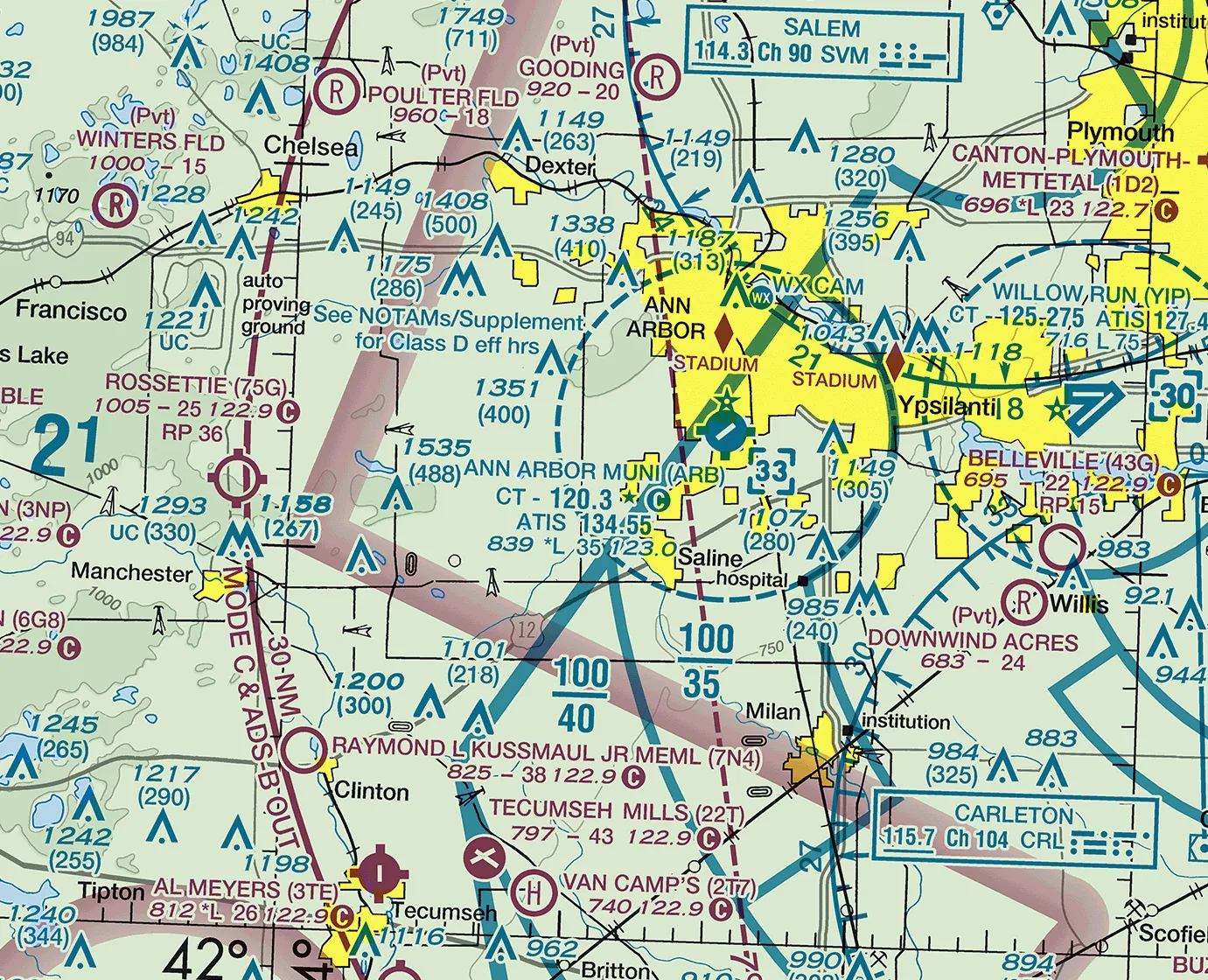
FAA Detroit sectional, 29 OCT 2026 edition. For briefing, not for navigation: fly from the current chart. Tap the chart to open it full size.
Today's flight
The person you named in lesson 2 wants a photo of the test track at the Chelsea Proving Grounds, and the day you can bring them, you will circle it so they can shoot out the window. Today the instructor plays the friend with the camera. But the wind has picked up since you checked this morning, and clouds are building in the west, which is the way you are going.
Before you leave, you decide what would send you home: a turn-back trigger, something you can see or read. In the air you watch for it, and when it happens you call it. This takes two flights. The first is on a day with a steady wind: you fly a steady track over the ground and the photo circle. The second is on a day when the weather is changing: you set the trigger, read the clouds, and spend a few minutes under the hood, because losing the horizon is what weather rolling in can do.
Every flight
Before every flight
P
Pilot.Am I fit to fly today? IMSAFE:
Illness
Medication
Stress
Alcohol
Fatigue
Emotion, and eating
A
Aircraft.Is this airplane ready, and right for today? Documents, inspections and open squawks; fuel and oil on board; weight, balance and performance for today's load.
V
Environment.What will today's flight meet? NWKRAFT, what 14 CFR 91.103 asks you to know before every flight, then the airspace and the route:
NOTAMs and TFRs
Weather, against your minimums
Known ATC delays
Runway lengths
Alternates
Fuel required, with reserve
Takeoff and landing distances
Airspace: the Class B limits from the current chart
The trip: heading, time, landmarks, wind and runway
E
External pressures.What is pushing me to go today: a passenger, a schedule, a plan I don't want to cancel? Would I go without it?
If it goes wrong.The takeoff emergency brief, out loud: an engine problem on the runway, after liftoff with runway left, and after liftoff without.
Who flies.Who does what today, and how we hand the controls back and forth.
Who runs it today:You, with the instructor's prompts.
Deeper today:Weather and The trip. You get the reports and forecasts yourself, work out the density altitude, and set a turn-back trigger before you leave. For the trip, say how the wind will push you on the way out and on the way back, and what that does to your heading and your time each way.
Recall
From earlier lessons
You are circling slowly so a passenger can see something, and the controls start to feel soft. What is happening, and what do you do?
Reveal answer
The wing is close to its critical angle of attack, and the bank has raised the stall speed. Roll toward level, lower the nose, add power.
What does trim do, and when do you use it?
Reveal answer
It holds the pitch attitude for you by taking away the control pressure. Set the attitude and power first, then trim the pressure off.
The engine fails at cruise. What is the first thing you do, and why that speed?
Reveal answer
Pitch for best glide and trim. It covers the most ground for each foot of altitude, which gives you the most fields to choose from.
On a damp 50 degree day the rpm slowly drops in cruise. What is the likely cause, and what do you do?
Reveal answer
Carburetor ice. Full carburetor heat, and leave it on even if the engine runs rough for a while as the ice melts.
WhyThe airplane moves through the air, and the air moves over the ground, so where you go is your heading plus the wind.
Wind and drift
Drift: in a crosswind you slide sideways. Point partly into the wind (a crab).
Groundspeed: highest with the wind behind you. The airspeed doesn't change.
The reports give the surface wind; the forecasts give it aloft.
Aloft, it is often stronger and from a different direction.
WhyThe traffic pattern is a rectangle around a runway in the wind. Practicing it over a field, away from traffic, makes the correction automatic.
Flying a track over the ground
Rectangular course: an even distance from a field's edges, crabbing on each leg.
S-turns: equal half circles either side of a straight road.
Turns around a point: steepest bank downwind, shallowest into the wind.
600 to 1,000 feet above the ground, clear of people, vehicles and buildings.
Turning downwind feels fast. It isn't. Don't pull the nose up.
WhyCircling something while someone else looks at it is where pilots get slow, low and distracted.
Circling for a photo
Set an altitude, a bank limit and a minimum airspeed before you start.
Fly by the airspeed and altitude, not the view.
The passenger looks. You fly and watch for traffic.
Not working: roll out, climb away, set it up again.
WhyOur weather usually arrives from the west, and the clouds tell you what the air is doing before the reports do.
Unstable air: puffy clouds that grow tall, bumps, showers.
A cold front: a line of building clouds and showers, then gusty wind behind it.
Towering clouds growing through the afternoon are a trigger by themselves.
WhyA thunderstorm is the one kind of weather a small airplane never tries, and its wind reaches miles beyond the cloud.
Thunderstorms and wind shear
Stay far away: severe turbulence can reach 20 miles from a severe storm.
Never take off or land with a storm coming.
Microburst: a downdraft that hits the ground and spreads. Headwind, then sink, then tailwind.
Signs: rain that doesn't reach the ground, a ring of blowing dust.
Wind shear near the ground: a sudden airspeed change. Add power, go around early.
WhyThe go or no-go is yours, and the reports tell you more than the view from the ramp.
Reading the weather
METAR: now, at an airport. TAF: the forecast for one. Graphical forecasts: in between.
Compare the last few METARs. Worse: rising wind, lower clouds, temperature and dew point closing.
Minimums: today the instructor's, plus the VFR minimums for the airspace.
Turn-back trigger: specific, observable, and set on the ground.
WhyWarm, humid air or low pressure makes the airplane perform as if the airport were higher than it is.
Density altitude
Pressure altitude, corrected for temperature.
Higher density altitude: a longer takeoff roll and a weaker climb.
Work it out from the elevation, altimeter setting and temperature, with an E6B or app.
KARB is low, but a hot summer day can push it far higher.
WhyWhen clouds roll in and the horizon goes away, the instruments are all you have, and your body will lie to you.
Under the hood
A few minutes with a view-limiting device, while the instructor watches for traffic.
Wings level and a gentle turn on the attitude indicator, cross-checked.
A slow turn can feel level. Believe the instruments.
The real lesson: turn back before the horizon goes. The trigger is the plan.
A real accident
On March 3, 2020, a pilot flying a Cessna 172S near Lincoln, Illinois, was circling a bald eagle nest so two ecologists on board could look at it. Track data showed the airplane's altitude and groundspeed dropping in a right descending turn. The last point was about 1,075 ft MSL, over ground at about 566 ft, at a groundspeed of 50 knots. Witnesses saw a wing drop and the airplane spin into a highway interchange; all three people on board were killed. A weather model showed the wind rising to 20 knots by 500 ft above the ground, with possible light low-level wind shear. The NTSB found that the pilot exceeded the wing's critical angle of attack while circling, likely letting the airspeed decay to give the passengers a better view or because of distraction, at an altitude too low to recover. Circling something for a passenger is today's scenario: the altitude, bank and airspeed you set before you start are what keep it safe, not the view. NTSB report CEN20FA110
Your calls
Decision points
On the ground: go or no-go with today's reports, and the turn-back trigger you set.
In the air: the trigger happens, or the instructor says it has. You call it, turn, and say where you are going.
During the photo circle: when to roll out and climb away.
The wind is stronger than forecast, or a cloud ahead is growing: what changes in the plan, and whether you still go.
The whole flight
Also on this flight
Part of the flight
Who
Every-flight routine, with the weather and the trigger
You, with the instructor's prompts
Preflight, start, taxi, runup
You
Radio calls, takeoff
You (the instructor, if you haven't flown lesson 6 yet)
Limits block for the route, from the current chart
You
Out to the practice area, correcting for the wind
You
First flight: rectangular course, S-turns and turns around a point, each at least twice in each direction
You
First flight: the photo circle, at least twice, inside the limits you set
You
Second flight: reading the clouds, and calling the turn-back trigger
You
Second flight: under the hood, a few minutes: wings level and at least two gentle turns
You fly; the instructor watches for traffic
One simulated failure, briefed before the flight (none if you haven't flown lesson 7 yet)
You fly; the instructor sets it up
Back to KARB, pattern and landing
You, with the instructor's help on the landing (the instructor lands if you haven't flown lesson 6 yet)
Shutdown and securing
You
Debrief
Both, you first
The standard
Ready to move on when
You fly a rectangular course, S-turns and turns around a point with a steady track over the ground, coordinated, without letting altitude or airspeed wander. By the checkride the ACS asks for altitude within 100 ft and airspeed within 10 knots (task V.B), clear of people, vehicles and buildings (14 CFR 91.119).
You get and decode the METAR, the TAF and the forecasts, and make a go or no-go with reasons you can say, against the VFR minimums (91.155).
You can explain stable and unstable air, what a cold front brings, and why you stay far from thunderstorms and microbursts.
You set a turn-back trigger on the ground that you can actually see, and call it in flight without being asked.
You can work out the day's density altitude and say what it does to the airplane.
You hold wings level and fly a gentle turn under the hood for a few minutes, and can say why a VFR pilot turns back early.
At home, before the next flight
Chair fly it
Find your airplane's demonstrated crosswind in its handbook (usually in Section 4, with the speeds for normal operation; older handbooks may put it elsewhere) and read what the handbook says it means.
Learn the crosswind component chart in Section 5 of your handbook. Take three recent KARB METARs and work out the crosswind for runways 06, 24, 12 and 30.
In chapter 9 of the Airplane Flying Handbook, approaches and landings, read Intentional Slips, and Crosswind Approach and Landing through Maximum Safe Crosswind Velocities.
Chair fly a crosswind takeoff: where the ailerons start, how they change as you speed up, and what your feet do.
Write down the largest crosswind you have flown so far. That number is where your personal minimum starts.
After the flight
Debrief
You go first, then the instructor. Three points at most, and you write down one thing to work on next time.
Your first turn-back trigger, set on the ground and called in the air: how did you know when it happened?
Where did the wind make the ground track hardest to hold, and what did you do about it?
What did you notice about your own sense of balance under the hood?
Before the flight
First flight: brief Wind and drift, Flying a track and Circling for a photo. Second flight: the clouds, thunderstorms, Reading the weather, Density altitude and Under the hood.
Flight one wants a steady wind: enough to make drift obvious, not enough to make the maneuvers rough. Flight two wants changing weather safely far off: real clouds building in the west are ideal; otherwise announce the trigger as a scenario in the air, and say beforehand that you may.
If you fly this before lessons 6 or 7 (it needs only lesson 5), you do the radio and the landing, and there is no simulated failure.
Check the student's weather work before you add anything. Ask what changed since the morning and what they would do if it changes again.
Agree on the photo circle's altitude, bank limit and minimum airspeed before departure, and pick ground references over open fields.
Bring the view-limiting device and brief the hood stretch: short, gentle, and you watch for traffic the whole time.
Background: weather theory is the PHAK's Weather Theory chapter (Atmospheric Stability, Air Masses, Fronts, Low-Level Wind Shear and microbursts: 1 to 2 miles across, downdrafts up to 6,000 fpm, a lifespan of 5 to 15 minutes). Thunderstorm avoidance is AIM 7-1-26 and 7-1-27: severe turbulence up to 20 miles from severe storms, and never take off or land with one approaching. Sources: aviationweather.gov for reports and forecasts, and 1800wxbrief.com for a briefing that also leaves a record (91.103). The hood time counts toward 61.109(a)(3), and lesson 16 builds on it.
In the air
Clear the area and pick references away from Rossettie's pattern and the Chelsea hospital helipad.
Common errors: correcting drift with rudder instead of heading, bank not changed with groundspeed, altitude lost in the downwind turns, eyes fixed on the point instead of scanning, and pulling the nose up in the downwind turn.
On the photo circle, watch airspeed and coordination closely. If the airspeed starts to decay, ask what the student sees before saying anything.
Under the hood, keep it to a few minutes and a gentle turn. Let them feel one mild illusion if conditions allow, then take the hood off and talk about it.
If the student doesn't call the trigger when it happens, ask what they see rather than calling it for them.
If it isn't working (ground reference maneuvers fall apart), go back to one straight leg along a road, crabbing, until the track holds, then add the turns.
Curveballs
All briefed before the flight: "I may tell you something has changed."
"The KARB wind just went above what we briefed": the student decides whether that is the trigger.
A cloud you point at to the west, growing: the student says what kind of air it means and what they will do.
The friend asks to circle lower for a better shot: the student says no, or sets a new limit that is still safe.
A turn-back point you name early, before the trigger: the student turns, says where they are going, and gives the new heading.
Under the hood, a turn you start slowly while they think they are level: then hood off and talk about it.
After the flight
Praise a turn-back made for a good reason. It is the best result this flight can have.
Log the hood time as instrument training toward 61.109(a)(3).
Note the strongest wind the student flew well in. It starts their personal minimums.