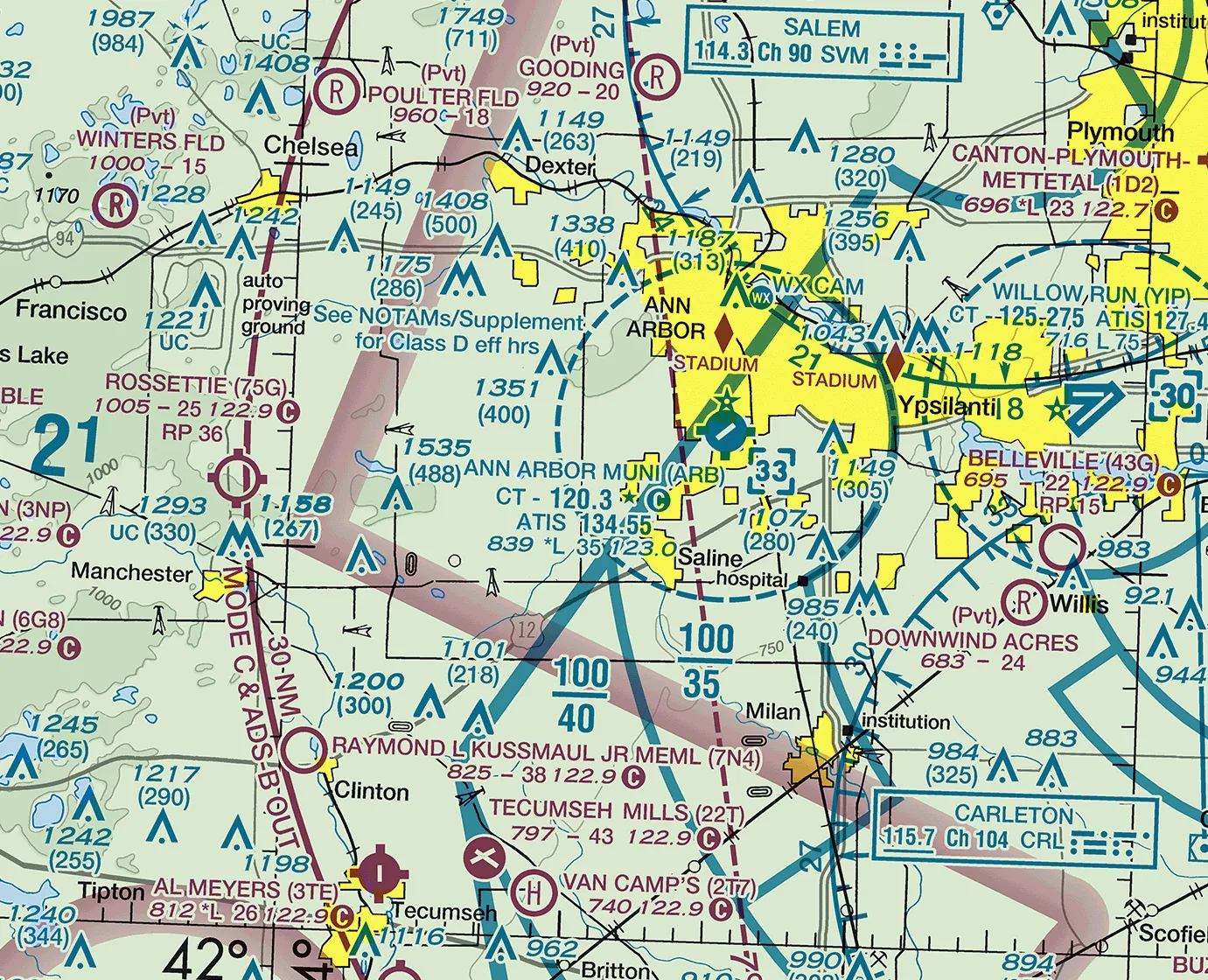
FAA Detroit sectional, 29 OCT 2026 edition. For briefing, not for navigation: fly from the current chart. Tap the chart to open it full size.
Today's flight
Where exactly does the Detroit Class B touch the ground east of Willow Run, and how far is that from the runway you will land on? Today you need to know before the engine starts.
Soon you will fly alone to two airports near home to practice takeoffs and landings. Today you check them out with me: Tecumseh Mills (22T), a field with no tower, and Willow Run (KYIP), a busy towered field under the Class B. Then home to KARB. It's your first flight east of KARB, and your first landings anywhere but home. Every trip you named in lesson 2 ends like this: arriving at a field you have only seen on the chart and in the Chart Supplement.
It takes two flights: this way around the triangle today, and the other way next time, so each route is flown in both directions.
Every flight
Before every flight
P
Pilot.Am I fit to fly today? IMSAFE:
Illness
Medication
Stress
Alcohol
Fatigue
Emotion, and eating
A
Aircraft.Is this airplane ready, and right for today? Documents, inspections and open squawks; fuel and oil on board; weight, balance and performance for today's load.
V
Environment.What will today's flight meet? NWKRAFT, what 14 CFR 91.103 asks you to know before every flight, then the airspace and the route:
NOTAMs and TFRs
Weather, against your minimums
Known ATC delays
Runway lengths
Alternates
Fuel required, with reserve
Takeoff and landing distances
Airspace: the Class B limits from the current chart
The trip: heading, time, landmarks, wind and runway
E
External pressures.What is pushing me to go today: a passenger, a schedule, a plan I don't want to cancel? Would I go without it?
If it goes wrong.The takeoff emergency brief, out loud: an engine problem on the runway, after liftoff with runway left, and after liftoff without.
Who flies.Who does what today, and how we hand the controls back and forth.
Who runs it today:You, unprompted. You brief me as your passenger, and I listen.
Deeper today:Airspace and The trip. For each of the three legs you fill in the limits block from the current chart (the floors you fly under, your maximum altitude, and your turn-back point before the surface area east of KYIP), and you give a rough heading, time, two or three landmarks of your own choosing, and the wind and likely runway at each field.
Recall
From earlier lessons
The wind shifted while you were out. How do you pick a runway, and what is plan B?
Reveal answer
The runway most nearly into the wind. Plan B is another runway or another airport, chosen before the crosswind is more than you have flown.
The engine runs rough at cruise altitude. What are your first three things?
Reveal answer
Fly the airplane at best glide (from the handbook), pick a place to land, then work the club checklist.
The airspeed jumps up and down on short final on a gusty day. What do you do?
Reveal answer
Hold the speed with pitch and power, with part of the gust added to the approach speed. If it won't settle by your gate, go around early.
Where does the Class B end west of KARB, and how do you know?
Reveal answer
Close west and north of the field. You know from the current chart, not from memory.
WhyThe chart is on every page of this course, and today every symbol on it matters.
Reading the chart
Airport symbols: blue means a tower, magenta means none. The legend shows the rest.
Solid blue lines: the Class B shelves, with their top over their floor. A dashed blue line: the Class D.
Maximum elevation figures: the big number in each box, the highest thing in it plus a margin.
Obstructions: towers, with their height above sea level and, in brackets, above the ground.
When a symbol is new, look it up in the legend before you guess.
WhyThe Class B sits over all three legs, and an altitude mistake under it is easy to make and hard to undo.
The limits block
Read every floor from the current chart. They step down as you go east.
Set a maximum altitude for each leg below its lowest floor, with room for a bump.
East of KYIP the Class B reaches the ground. Mark where, and pick a turn-back point.
Write it on your kneeboard. The block decides; the moving map is a backup.
WhyToday you find two airports with the chart and the ground, the way you will on every cross-country.
Pilotage
The chart gives you the course; you work out the heading and the time from today's wind.
Pick checkpoints you can't mistake: roads, towns, rail lines, water.
Note the time as you pass each one.
Find each airport from something big you can see, then look for the runway.
WhyAt 22T nobody sequences you. Your eyes and the other pilots' calls are all the separation there is.
A field with no tower
Read the field in the Chart Supplement first: runways, CTAF and pattern direction.
Listen from about 10 miles out, then say who you are, where, and what you'll do.
Pick the runway from the windsock and the traffic, and join on the 45 to midfield downwind.
Calls help; they don't separate. Keep looking for the straight-in.
WhyKYIP has long runways, jets and cargo traffic, and the Class B surface area just east of it.
Willow Run, in the air
Get the ATIS, then call the tower well west of the field. Read back every instruction.
A wide runway looks closer and lower than it is. Fly your normal pattern.
Taxiway G runs right next to runway 27. Make sure it's the runway before you land.
Leaving, tell the tower you're westbound, and never pass your turn-back point.
WhyA big airport with many taxiways is where pilots end up on a runway they weren't cleared onto.
Willow Run, on the ground
Before you land, look at the airport diagram: the taxiways, the ramps and any hot spots.
Call ground before you enter any taxiway from the ramp, and read back every hold short.
Red signs mean a runway. Stop at the hold line unless you are cleared across.
Not sure where you are: stop and ask ground. That is always allowed.
A real accident
On August 18, 2022, a Cessna 152 doing takeoffs and landings at Watsonville, California, a field with no tower, collided on final with a Cessna 340 that was flying a straight-in approach. Both pilots had been making position reports on the CTAF, but they did not talk to each other until the twin was about a mile out and the 152 had turned base. The 152 pilot announced a go-around, and the airplanes collided about 150 feet above the ground; all three people aboard died. The NTSB found the probable cause was the twin pilot's failure to see and avoid the 152 during the straight-in; he kept about 180 knots of groundspeed all the way in. The calls were made and the collision happened anyway: the time to sort it out was when the twin first called a straight-in while the 152 was on downwind. At 22T today you listen, picture where everyone is, and keep looking for the airplane that doesn't fly the pattern. NTSB report WPR22FA309
Your calls
Decision points
The limits for each leg, from the chart, before engine start. I may ask you to defend one.
Which runway at 22T, from the windsock, the wind and the traffic, and how you join the pattern.
At KYIP, if an instruction would take you toward the surface area or you aren't sure of it, you ask, or say "unable."
Whether to fly the next leg. If the weather, the wind or the clock doesn't support it, you say so and we go home.
The whole flight
Also on this flight
Part of the flight
Who
Every-flight routine, limits block, trip
You, unprompted; you brief me
Preflight, start, taxi, runup
You
Takeoff and departure from KARB
You
Navigation by pilotage on each leg, a time at each checkpoint
You
Radio: KARB tower, 22T CTAF, KYIP ATIS, tower and ground
You; I help with the first KYIP call if the frequency is busy
Patterns, takeoffs and landings: at least three at 22T and three at KYIP
You
Taxi at KYIP, with the airport diagram
You
One simulated failure, briefed before the flight
You; I set it up
Back to KARB, pattern and landing
You
Shutdown and securing
You
Logging the training for solo at each field
Instructor
Debrief
Both, you first
The standard
Ready to move on when
You fill in the limits block for every leg from the current chart without help, and you fly inside it.
You can name every symbol on the chart along the triangle, or find it in the legend.
You find both airports by pilotage and join each pattern the way that kind of field calls for.
Your calls at 22T and KYIP are clear and complete, you read back the tower and ground correctly, and you taxi at KYIP without a wrong turn or a missed hold short.
You have flown KARB to 22T and KARB to KYIP in both directions, with patterns, takeoffs and landings at each, as 14 CFR 61.93(b)(1) requires before you solo there.
Your airspace, radio, pattern and pilotage work meets the spirit of tasks I.E, III.A, III.B and VI.A in the Private ACS.
At home, before the next flight
Chair fly it
Next is the pre-solo check. Read 14 CFR 61.87 and 61.89: what you need before solo, and what a student pilot may never do.
Start studying for the pre-solo knowledge test; it's due before lesson 11. Begin with 14 CFR 91.103, 91.113, 91.126, 91.151 and 91.155 on eCFR, KARB in the Chart Supplement, and the limitations section of your airplane's handbook (linked from its page on michiganflyers.org/aircraft).
Chair fly a KARB pattern with nobody helping: every call, every checklist item, and where you would go around. The club's traffic pattern guide for your airplane is on its Resources page.
Say today's radio calls once more, at 22T and at KYIP, ground included.
After the flight
Debrief
You go first, then the instructor. Three points at most, and you write down one thing to work on next time.
Your first landing away from home: what did you do differently at 22T and at KYIP to make it work?
How well did your limits block work in the air? Where did you come closest to it?
If you flew to 22T alone next week, what would you want to practice first?
Before the flight
Check the student's limits block against the current sectional and terminal area chart yourself. Ask questions about anything wrong; don't correct it for them.
From FAA data: KARB to 22T is about 13 NM on a true course near 208; 22T to KYIP about 20 NM near 051; KYIP to KARB about 10 NM near 264.
From the FAA airport data effective 29 October 2026 (recheck the current Chart Supplement): 22T has runways 7/25 and 13/31, CTAF 122.9, no right traffic listed (so left turns, 14 CFR 91.126), no fuel listed, unattended, displaced thresholds on 7, 13 and 31, and a remark about deer and large birds. KYIP has a tower listed as open 24 hours, tower 125.275, ground 119.975, ATIS 127.425, runways 5/23 and 9/27 with left traffic, the taxiway G wrong-surface remark and a landing fee based on weight. Know the club's practice on the KYIP fee.
The FAA's KYIP pilot sheet (updated June 2026; recheck it): taxiway G is close and parallel to runway 27, which is darker asphalt; a closed former runway marked with X's lies just north of runway 5; the east, west and south ramps are uncontrolled, so call ground before entering any active taxiway; the tower may run left or right traffic depending on the wind; read back runway assignments and hold shorts with your call sign. The sheet's text didn't list any hot spots. Have the student check the current airport diagram for them.
61.93(b)(1) needs training at each field, flight in both directions over the route, pattern entries and exits, and takeoffs and landings there. This triangle flies KARB to 22T and KYIP to KARB; the reverse triangle on the second flight flies the other two.
Pick a day with light wind.
If it isn't working (the block is wrong, or the student is behind at KYIP), skip 22T or KYIP for today and fly that field again on the second flight.
In the air
Common errors: climbing into a shelf on the 22T to KYIP leg as the floors step down; descending while joining the 22T pattern; joining the 45 from the wrong side; at KYIP, turning base early or late against the wide runway, or lining up on taxiway G; incomplete readbacks; a wrong turn on the KYIP taxiways; drifting east after the KYIP departure.
Let the student make every KYIP call. Step in only if the frequency is busy and they are stuck.
Curveballs
All briefed before the flight; before solo there are no surprises.
At 22T, call yourself as a simulated straight-in on the CTAF while the student is on downwind, and see how they sort it out.
At KYIP, say the tower has asked for an extended downwind toward the east, and see whether they stop at the turn-back point and say "unable."
Give a runway change at KYIP on downwind.
On the ground at KYIP, ask them to taxi to a ramp they haven't used, from the diagram.
Before the last leg, give a marginal weather report and let them decide whether to go on or go home.
After the flight
Mark the first: the first landing away from KARB.
Log the training with the routes and the directions flown, so the 61.93(b)(1) endorsements in lesson 14 have a record behind them.
Note which directions are still to fly and plan them for the next flight.
If the student is close to solo, write the pre-solo knowledge test now. The airport part should be about KARB.