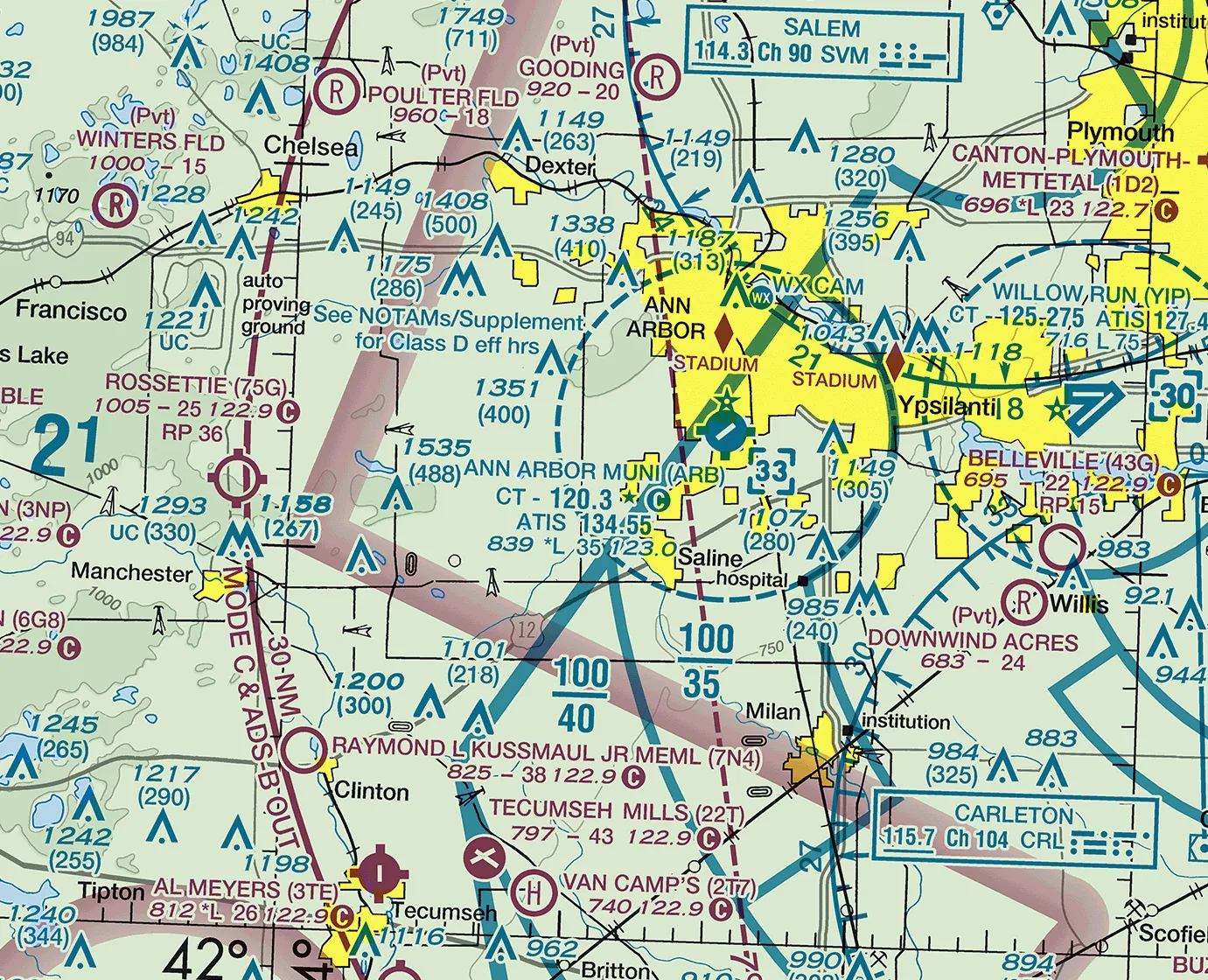
FAA Detroit sectional, 29 OCT 2026 edition. For briefing, not for navigation: fly from the current chart. Tap the chart to open it full size.
Today's flight
A Saturday afternoon at KARB, and everyone is coming home at once. The tower is handing out sequences, a business jet is landing ahead of you, and halfway around the pattern the wind shifts enough that the tower changes runways. Then: "Number two, follow the Cessna on base." Now you have to find that Cessna, fly behind it and keep your own spacing. Every trip you ever fly, yours from lesson 2 included, ends with a call like this one.
You build up to that Saturday over two or three flights. The first is at a quieter time: taxi, takeoffs, laps and landings, with every radio call yours. You fly your first landings, with the instructor ready to help, and you practice the most useful maneuver near the ground: the go-around. The busy Saturday is the repeat.
Every flight
Before every flight
P
Pilot.Am I fit to fly today? IMSAFE:
Illness
Medication
Stress
Alcohol
Fatigue
Emotion, and eating
A
Aircraft.Is this airplane ready, and right for today? Documents, inspections and open squawks; fuel and oil on board; weight, balance and performance for today's load.
V
Environment.What will today's flight meet? NWKRAFT, what 14 CFR 91.103 asks you to know before every flight, then the airspace and the route:
NOTAMs and TFRs
Weather, against your minimums
Known ATC delays
Runway lengths
Alternates
Fuel required, with reserve
Takeoff and landing distances
Airspace: the Class B limits from the current chart
The trip: heading, time, landmarks, wind and runway
E
External pressures.What is pushing me to go today: a passenger, a schedule, a plan I don't want to cancel? Would I go without it?
If it goes wrong.The takeoff emergency brief, out loud: an engine problem on the runway, after liftoff with runway left, and after liftoff without.
Who flies.Who does what today, and how we hand the controls back and forth.
Who runs it today:You, with the instructor's prompts.
Deeper today:Airspace and NOTAMs. Read KARB's own listing in the Chart Supplement: the Class D, the tower's hours (given in UTC: turn them into local time yourself), the frequencies, and what the airspace becomes when the tower is closed. Find the airport diagram and any hot spots on it. Then check the NOTAMs for anything that changes them today: a closed runway or taxiway, a light out, different tower hours.
Recall
From earlier lessons
You are following a slow airplane on final and have to slow down. What tells you slow is becoming too slow, and what do you do?
Reveal answer
Soft, mushy controls, the stall warning, and a nose that needs more and more back pressure to hold. Add power and lower the nose. If the spacing still doesn't work, go around.
You overshoot the turn from base to final. Why is steepening the bank to fix it a trap, and what do you do instead?
Reveal answer
More bank means a higher load factor, so the wing stalls at a higher airspeed, and near the ground with uncoordinated rudder that is how a spin starts. Go around.
You go around with the trim still set nose up for the approach. What happens when you add full power, and what do you do?
Reveal answer
The nose pitches up hard, toward an elevator trim stall. Push forward to hold the climb attitude, then retrim.
What are the three parts of the takeoff emergency brief?
Reveal answer
An engine problem on the runway, after liftoff with runway left, and after liftoff with no runway left.
WhyThe tower keeps traffic apart at a busy field, but only when every pilot hears what it says and says what they will do.
Class D and the tower
Class D: the dashed blue line around KARB on the chart. Read its top from the chart.
Talk to the tower before you enter, and get a clearance for every runway.
Tower closed: it becomes Class G, the tower frequency is the CTAF, and the Class B above stays.
Special VFR: a tower clearance to fly below normal VFR minimums. Not something to plan on.
A clearance is not protection: you still see and avoid.
WhyA good call is short, in the order the controller expects, and you know what you will say before you press the button.
Talking to the tower
ATIS first, and say its letter in your first call.
Ground for taxi, tower for the runway.
Who you're calling, who you are, where you are, what you want.
Read back runways, hold short instructions and clearances. Missed it? "Say again."
"Unable" is a full answer, with what you can do instead.
WhyMost runway incursions are pilots on the ground, and the signs and the airport diagram are how you avoid being one.
Taxiing at a towered field
Red sign, white letters: a runway or a hold point. Stop unless cleared.
Black sign, yellow letters: where you are. Yellow sign, black letters: which way to go.
Hold short lines: stop at the solid side, and cross only with a clearance.
Hot spots are on the airport diagram. Know them before you taxi.
Read back what was said, not what you expected. Unsure? Ask for progressive taxi.
WhyEveryone flies the same shape, so everyone knows where to look.
The pattern at KARB
Departure, crosswind, downwind, base and final, or the entry the tower gives you.
Pattern altitude: 1,000 feet above the field, unless the Chart Supplement says otherwise.
The club's pattern sheet shows where power, flaps and speed change.
Following someone: extend downwind or slow down, never a steep turn.
"Traffic in sight" only when you see it. Until then, "looking."
WhyIt turns any bad approach into a safe second try, so it has to be automatic and never embarrassing.
The go-around
When: not on speed, path and centerline by the gate, the runway isn't clear, or it feels wrong.
How: full power, pitch for the climb, flaps up in steps.
Move a little to the side so you can see traffic below.
Fly first, then talk: "Cessna 345, going around."
Early beats late. Decide early.
WhyThe runway tells you where to land, and the glide path lights tell you whether you will get there.
Runway lights and glide path lights
KARB has a PAPI at one end and a VASI at the other. Find which in the Chart Supplement.
Learn what on path, high and low look like on each.
Runway markings: the number and the centerline. Pick your touchdown spot past the threshold.
WhyA loose plug or a stuck mic is common, and a towered field still has a way to talk to you.
When the radio goes quiet
Check the simple things: headset plugs, volume, frequency, a stuck mic.
Still nothing: squawk 7600.
Stay outside or above the Class D until you see the traffic flow, then join the pattern.
Watch the tower for light signals. In daylight, rock your wings to answer.
WhyA bigger airplane leaves two invisible spinning vortices behind it, strong enough to roll a small one near the ground.
Wake turbulence
They trail from the wingtips from rotation to touchdown, sink, and drift with the wind.
Landing behind a bigger airplane: stay above its path and land beyond its touchdown.
Departing behind one: lift off before its rotation point, or wait.
A caution from the tower is information, not separation.
Light wind is the worst case: it can hold a vortex over the runway.
A real accident
In June 1998 a student pilot on a solo flight in a Cessna 152 was in a busy pattern at John Wayne Airport, Santa Ana, California, flying full-stop landings. The tower pointed out a Boeing 757 landing on the parallel runway ahead of him, issued a wake turbulence caution, and cleared him. At about 100 ft on short final the airplane rolled abruptly, the nose dropped, and it hit the ground short of the runway; the student was killed. The NTSB found that he did not pick a touchdown point and a glide path that kept him clear of the 757's wake, and that not going around, with the wake known to be there, was a factor. An instructor on final behind him had planned to stay high and land long for exactly that reason. The tower's caution put the decision in the pilot's hands, and today you practice making it. NTSB report LAX98FA210
Your calls
Decision points
On final, the airplane ahead is slow to clear the runway: when you go around, and saying so.
The tower changes runways while you are on downwind: can you take the new one, or do you ask for something else?
"Follow the Cessna on base," and you can't find it: what you tell the tower, and what you fly until you see it.
A bigger airplane lands ahead: where you will touch down, or whether you go around.
A taxi clearance you aren't sure of: read back, ask again, or ask for progressive.
The whole flight
Also on this flight
Part of the flight
Who
Every-flight routine, with the Chart Supplement and airport diagram
You, with the instructor's prompts
Preflight inspection
You; the instructor checks
ATIS and every radio call
You; the instructor helps with the words
Engine start, taxi with the airport diagram, runup
You
Takeoffs and climbs
You
Pattern, spacing and entries
You
Landings: at least six each flight
You, with the instructor's help: your first ones
Go-arounds: at least two each flight, one the instructor calls and one you call
You
Shutdown and securing
You
Debrief
Both, you first
The standard
Ready to move on when
You make every radio call in a pattern session with the right parts in the right order, and read back runways and hold short instructions without a prompt.
You taxi by the signs and the airport diagram, and stop at every hold short line unless cleared across.
You fly the pattern at the right altitude, and fix spacing behind other traffic without steep turns.
You go around as soon as you or the instructor calls it, in the order the checklist gives, and then tell the tower.
Most of your landings need the instructor's words, not hands. Lesson 9 adds the crosswind, and the ACS tasks for this lesson set where they end up by the checkride.
You can say each light gun signal (14 CFR 91.125), what to do arriving at KARB with a failed radio (AIM 4-2-13), and what changes when the tower is closed (91.126).
At home, before the next flight
Chair fly it
Read the emergency procedures section (Section 3) of your airplane's handbook and the emergency side of the club checklist, both linked from the airplane's page on michiganflyers.org/aircraft. Find the best glide speed; you will want it without looking next time.
Chair fly the engine failure in flight items from the club checklist, out loud, until they come in order without the card.
Find Rossettie (75G) on the chart and in the Chart Supplement: its runway, surface, length and pattern direction.
After the flight
Debrief
You go first, then the instructor. Three points at most, and you write down one thing to work on next time.
Your first call to the tower and your first landings: which landing was your best, and why?
When did you decide to go around, and was that the right moment?
How long did it take to find the traffic you were following, and where did you look?
Before the flight
First flight: brief Class D, Talking to the tower, Taxiing, The pattern and The go-around. Leave lights, the quiet radio and wake turbulence for the repeat flights.
Fly the first session at a quieter time; the busy Saturday of the scenario is for the repeat. Plan two or three flights in all, until most landings need words, not hands.
Have the student translate the tower hours from UTC themselves. In the Chart Supplement effective 29 Oct 2026: tower and CTAF 120.3, ground and clearance delivery 121.6, ATIS 134.55, tower 1300 to 0100Z with the daylight saving symbol (8 a.m. to 8 p.m. local all year), Class G when the tower is closed. Check the current edition before you rely on this.
Set the stabilized gate and agree that a go-around is never wrong, before engine start.
Brief how you will help on landings: you may follow on the controls, and if you take them, it's with the positive exchange.
Background: two-way radio contact before entering Class D is 91.129; light signals are 91.125 and AIM 4-3-13 (on the ground, flashing green is cleared to taxi, steady red stop, flashing red taxi clear of the runway, flashing white return to the starting point; acknowledge on the ground by moving the ailerons or rudder, at night by blinking a light); arriving with a failed radio is AIM 4-2-13 (stay outside or above the Class D until you have the traffic flow, then join and watch for lights); 7600 is AIM 6-4-2. Signs are AIM 2-3-7 to 2-3-12, and the PHAK's Airport Operations chapter covers hot spots and runway incursion avoidance. Pattern altitude: the Chart Supplement lists none for KARB, so the AIM 4-3-3 standard of 1,000 feet above the field applies. Glide path lights are AIM 2-1, wake turbulence AIM 7-4.
Special VFR (91.157): in the surface area, with a clearance, clear of clouds, 1 statute mile visibility, by day unless instrument rated in an IFR airplane. A student pilot still needs 3 miles by day (61.89(a)(6)), so special VFR isn't a tool for this course.
In the air
Let the student talk. Give the words only after a pause, and don't key the mic for them unless traffic needs it.
Common errors: calling without listening first, long calls, missing a hold short readback, hearing the expected taxi route instead of the one given, losing the traffic to follow, steep turns to fix spacing, pitching up before adding power on the go-around, raising all the flaps at once.
Point out the Chart Supplement note that the runway 24 runup area and part of taxiway A1 can't be seen from the tower, and what that means for how carefully you read back.
If a jet or a twin lands, use it: where it touched down, and where you will.
Keep the first landings short of perfect on purpose: a safe arrival is the standard today, not a pretty one.
If it isn't working (the radio swamps the flying), take the radio for a few laps so the student can fly, then hand it back one call at a time.
Curveballs
All briefed before the flight.
A go-around you call on short final, for no stated reason: the student flies it, then tells the tower.
You play tower for a runway change on downwind: the student says whether they can take it.
A lost radio, simulated by turning down the volume on downwind: the student checks the plugs and volume, then says what they would do.
A request for an entry the student hasn't flown (a straight-in, or right traffic): the student says "unable" or flies it.
A taxi route with a runway crossing: the student reads back the hold short and stops at the line.
After the flight
Replay one radio call: what the student said, and what they would say now.
Count every go-around as a success in the debrief and in the logbook remarks.
If the landings need more, repeat the lesson. Lesson 9 keeps building them in crosswind.