Today's flight
A hundred and sixty-two miles, three airports, and nobody in the right seat. Every go or no-go on these trips is yours, and the instructor checks your planning before signing each flight off.
First, the club's Pre-Solo Cross-country Phase Check, flown with another instructor. Then three solo cross-countries, each with its own endorsement. First Charlotte (KFPK), a quiet field with no tower, and back. Then Battle Creek (KBTL), the towered field you flew to dual, and back. Then the long one: KARB to Jackson (KJXN), Jackson to Sturgis (KIRS), and Sturgis home, 162 NM with three full-stop landings. If the trip you named in lesson 2 meets the same requirements, fly that one instead. The long one takes most of a day: book the airplane for half a day or more.
Every flight
Before every flight
- P
Pilot. Am I fit to fly today? IMSAFE: - Illness
- Medication
- Stress
- Alcohol
- Fatigue
- Emotion, and eating
- A
Aircraft. Is this airplane ready, and right for today? Documents, inspections and open squawks; fuel and oil on board; weight, balance and performance for today's load.
- V
Environment. What will today's flight meet? NWKRAFT, what 14 CFR 91.103 asks you to know before every flight, then the airspace and the route: - NOTAMs and TFRs
- Weather, against your minimums
- Known ATC delays
- Runway lengths
- Alternates
- Fuel required, with reserve
- Takeoff and landing distances
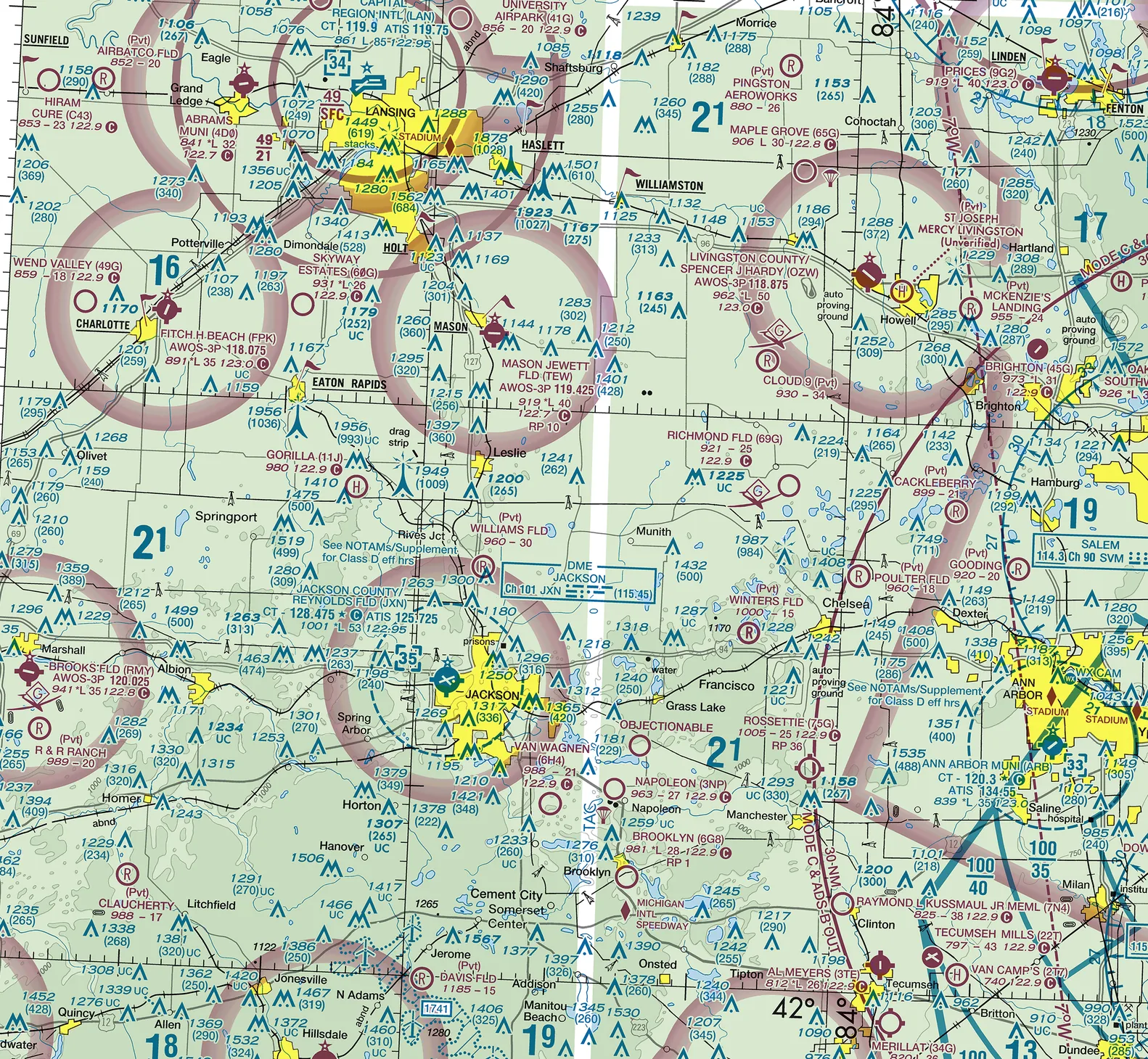
- Airspace: the Class B limits from the current chart
- The trip: heading, time, landmarks, wind and runway
- E
External pressures. What is pushing me to go today: a passenger, a schedule, a plan I don't want to cancel? Would I go without it?
-
If it goes wrong. The takeoff emergency brief, out loud: an engine problem on the runway, after liftoff with runway left, and after liftoff without.
-
Who flies. Who does what today, and how we hand the controls back and forth.
Who runs it today: You, alone. The instructor checks it before endorsing each flight.
Deeper today: The trip, Weather and Pilot, with nobody else to catch a mistake. The trip: a navigation log for every leg, fuel at every stop, a diversion airport for every leg, and the time you must be home. Weather: checked against the limits in your endorsement, the day before and the morning of, for every airport and the route. Pilot: a long day alone is tiring, so plan food, water and a rest at each stop.
Recall
From earlier lessons
When does the rule's "night" start for logging, and how much fuel reserve does a VFR flight need at night?
Reveal answer
At the end of evening civil twilight (14 CFR 1.1). 45 minutes beyond the first landing at night, 30 by day (91.151).
You are not sure where you are on a cross-country. What do you do?
Reveal answer
Keep flying the airplane and the heading. Go back to the last checkpoint you were sure of and the time since, look for a big feature on the chart, use the navigation radios or GPS, and ask ATC for help early.
How is a solo flight to 22T or KYIP under 61.93(b)(1) different from a solo cross-country?
Reveal answer
61.93(b)(1) allows takeoffs and landings at another airport within 25 NM after training there in both directions. A solo cross-country needs the 61.93(c) endorsements, including one for each flight after the instructor reviews your planning.
When should you make a precautionary landing, and why early?
Reveal answer
When the weather is closing in, you're lost, the fuel is getting short or the engine is slowly getting worse. Early, while you still have power and daylight to pick and fly a good approach (lesson 18).
Why Alone on a cross-country nobody catches a planning error in the air, so the rule puts an instructor's eyes on every plan before you go.
The endorsements and who checks what
- Once: solo cross-country endorsements for the category and for the make and model.
- Every flight: the instructor reviews your plan and signs that it is correct and you're ready.
- Your limits are in your logbook, set within the club's. Breaking one breaks the rule.
Why The rule sets the minimum, and your trips have to meet every part of it, measured the way the rule measures.
What the trips must add up to
- The long one: 150 NM total, full stops at three points, one leg over 50 NM in a straight line.
- Each trip lands more than 50 NM from KARB, so each one counts as cross-country time.
- Together they make up the 5 hours of solo cross-country. Short? Fly another one.
- Three solo full-stop landings at a towered airport: KBTL, KJXN, KARB or KYIP, with the tower open.
Why Course and distance never change, so they can be worked out once; everything else depends on the day.
The routes
- KFPK: 294 degrees true, 51.8 NM; back, 114.
- KBTL: 275 degrees true, 67.0 NM; back, 094.
- The long one: KJXN 274 and 31.9 NM, KIRS 239 and 51.2 NM, home 071 and 79.4 NM.
- Every trip ends under the Class B edge west of KARB: the arrival limits block goes on the log.
Why Each stop is a different kind of field, and the Chart Supplement tells you what to expect before you see it.
The airports
- KFPK: no tower, a paved and a turf runway. Read the remarks about helicopters and airplanes without radios.
- KBTL: a busy tower and training traffic. Decline land and hold short.
- KJXN: a part-time tower. Know what the airspace and the frequency become when it closes.
- KIRS: no tower, two paved runways and automated weather.
Why The cross-country accidents follow a pattern: a small error left alone, then fuel, weather or darkness finishes it.
Staying ahead in the air
- At each checkpoint write the actual time. Early or late tells you the real wind; update the times and fuel.
- A checkpoint that doesn't show up is the moment to act, not five minutes later.
- Ask for flight following on each leg. Unsure of your position? Say so to ATC early.
- At each stop: fuel, weather, the time and how you feel. Landing and waiting is always allowed.
- Be home with your fuel reserve, in daylight and within your limits.
A real accident
On January 16, 2004, a 17-year-old student pilot with about 30 hours left Madison, Indiana, in a Cessna 150L on his first solo cross-country, to Middletown, Ohio, and back. He flew past Middletown and landed at an airport about 21 NM beyond it, got directions, flew back and landed at Middletown, and left for home at 5:35 in the afternoon. It got dark on the way, he flew past Madison by about 48 NM without knowing it, and he was circling a water tower to find out where he was when the engine quit from fuel exhaustion; he landed in trees and the airplane came to rest inverted, with minor injuries to him. His navigation logs were not complete or accurate, and he had no night time logged. The NTSB's probable cause was the student becoming lost and the instructor's inadequate supervision of both the flight and the preflight planning, leading to fuel exhaustion. The chain could have broken at the first missed checkpoint, at the unplanned landing (refuel, call the instructor, wait for daylight), or before takeoff, with a reviewed log that added up: that is what the review before each endorsement is for. NTSB report CHI04LA057
Your calls
Decision points
- Go or no-go each morning, against the limits in your endorsement. The instructor checks your decision before signing; the decision is still yours.
- At each stop: continue, wait for the weather, or stay. Is there fuel, daylight and energy for the rest?
- In the air: a checkpoint doesn't appear, or the weather ahead is worse. Continue, divert to the airport you planned, or turn around.
- At KFPK or KIRS the wind favors a runway that is shorter, or the crosswind is beyond your limit. Which runway, or a different airport?
The whole flight
Also on this flight
| Part of the flight | Who |
|---|
| Pre-Solo Cross-country Phase Check | You, with another instructor, on the club's form |
| Planning, weather, NOTAMs, weight and balance, navigation log, for each trip | You |
| Review of the planning and the endorsement for each flight | Instructor |
| Every-flight routine | You, alone |
| Preflight, departure and the Class B edge west of KARB | You |
| En route: actual times at every checkpoint, fuel, flight following, diversions | You |
| Arrivals at towered fields and at fields with no tower | You |
| A call to the instructor from each stop, and fuel and rest | You |
| Return under the Class B edge, pattern and landing at KARB | You |
| Logbook: solo cross-country time and each landing | You; the instructor checks |
| Debrief after each trip | Both, you first |
The standard
Ready to move on when
- You passed the club's Pre-Solo Cross-country Phase Check.
- You flew all three solo cross-countries, each with its own 61.93(c)(3) endorsement, and the long one meets 61.109(a)(5)(ii).
- Your navigation logs have actual times at every checkpoint, and the fuel you landed with matches your plan within reason.
- You can explain each go or no-go you made, including any trip you called off.
- Your logbook shows the 5 hours of solo cross-country and three solo full-stop landings at a towered airport, or you have a plan to finish them.
At home, before the next flight
Chair fly it
- Read the skill elements of tasks IV.A to IV.F, IV.M and IV.N (takeoffs, landings, slips and go-arounds) in the Private Pilot ACS. Areas V and VII can wait for the second polishing flight.
- Chair fly the takeoffs and landings with the club checklist in hand, saying the flow and the standard out loud.
- Think of a place near Chelsea or Jackson you would like to show a friend from the air: the next lesson is flown as that trip.
After the flight
Debrief
You go first, then the instructor. Three points at most, and you write down one thing to work on next time.
- Your first cross-country alone: which moment will you tell people about?
- Where did the real flight differ most from your plan, and when did you notice?
- Which decision on these trips are you most sure was right, and why?
Before the flight
- Schedule the club's Pre-Solo Cross-country Phase Check with another instructor before the first solo cross-country, on the club's form.
- Review each plan with the student in person: does the log add up (distances, times, fuel), does the weather work for the whole day, are the NOTAMs read, is the weight and balance done. This lesson's accident (CHI04LA057) shows what a log that doesn't add up leads to.
- Write the endorsements from AC 61-65K (A.9 for the category and make and model, A.10 for each flight), with the limits you set within the club's limits.
- Agree how the student will call you from each stop, and what you will do if a call doesn't come.
- Check the tower hours against the planned arrival at any stop meant to count toward 61.109(a)(5)(iii). KARB and KYIP count too, with the tower open, and the solo flights to KYIP under 61.93(b)(1) may already have done it.
- Sources behind the slides: the endorsements, 14 CFR 61.93(c)(1) to (3), and what the instructor checks first, 61.93(d); limits, 14 CFR 61.89(a)(8); the requirements, 14 CFR 61.109(a)(5)(i) to (iii), and cross-country time, 14 CFR 61.1. KJXN to KIRS (51.2 NM) and KIRS to KARB (79.4 NM) are both over 50 NM.
- The courses are great-circle initial true courses from the FAA's airport coordinates (NASR data effective 29 October 2026). The airport notes are from the Chart Supplement of 29 October 2026: KFPK's turf runway closes in winter; KJXN is a Class D with a part-time tower and two paved runways. The edition changes every 56 days; the student reads each listing and writes frequencies, runways, pattern, fuel and remarks on the log.
In the air
- You are on the ground: be reachable for the whole trip, and know the route, the times and the airplane.
- Common errors to brief beforehand: no actual times on the log, not updating the fuel after a slow leg, missing the CTAF calls at a field with no tower, a long leg with no flight following, and hurrying home late in the day.
- If the weather changes, the student's call to stay put is the right one. Say so when they call.
Curveballs
Set on the ground, before signing, or on the phone from a stop. Never in the air: the student is alone.
- Before signing: a new wind that changes the runway at KFPK or KIRS. They replan the arrival.
- Before signing: a NOTAM closing a runway at KJXN. They pick the other runway or another stop.
- Before signing: a departure two hours later than planned. Does the daylight still work?
- On the phone from the first stop: "The weather at the next field just dropped. What's your plan?"
After the flight
- Mark the first: the first cross-country alone, and the long one.
- Go through the log with the student: planned against actual for every checkpoint, and the fuel.
- Check the logbook entries against 61.109(a)(5) and note what is left.
- If the student's own trip from lesson 2 fits, plan it with them as the long cross-country or a later solo.