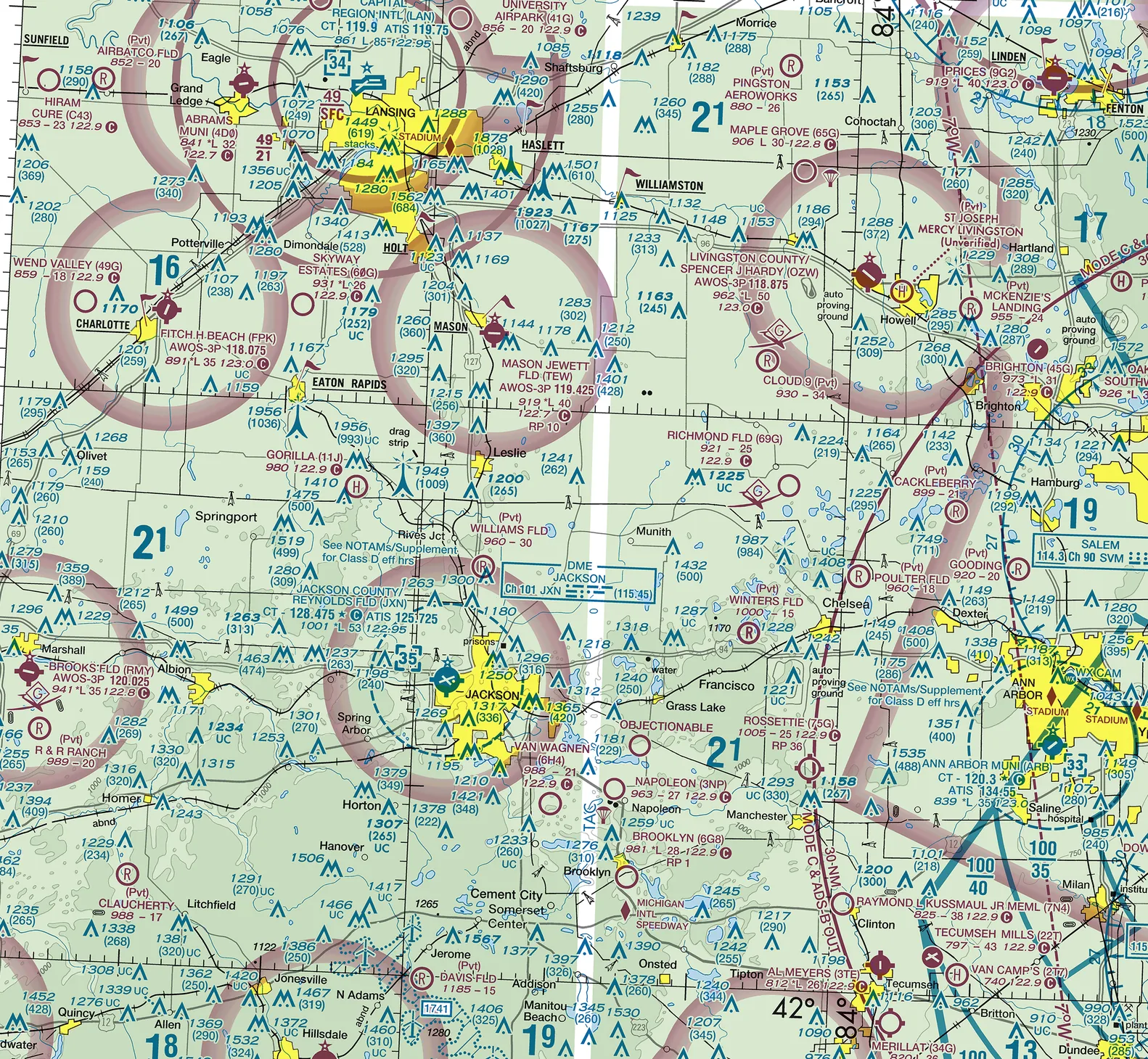
FAA Detroit sectional, 29 OCT 2026 edition. For briefing, not for navigation: fly from the current chart. Tap the chart to open it full size.
Today's flight
A summer Saturday morning at a small grass field: the kind of trip pilots make for breakfast and the fun of it. Today it is Brooklyn (6G8), southwest of KARB in the Irish Hills: one turf runway, 01/19, trees at both ends, and a power line off the end of runway 19. It is warm by mid-morning. If grass fields are part of the trip you named in lesson 2, this is where it starts.
Plan it for the day you can bring a friend. Before we go, the numbers decide: you work out from the handbook whether the airplane can get into Brooklyn and back out again with that load and this temperature, with your friend's weight in the back seat (in a 172) or in place of mine (in a 152), and a margin you are happy with. If it can't, something changes: less fuel, no friend that day, or an earlier start. At Brooklyn, we fly short-field and soft-field landings and takeoffs for real. It takes two flights: the first to learn the techniques at KARB, the second to Brooklyn.
Every flight
Before every flight
P
Pilot.Am I fit to fly today? IMSAFE:
Illness
Medication
Stress
Alcohol
Fatigue
Emotion, and eating
A
Aircraft.Is this airplane ready, and right for today? Documents, inspections and open squawks; fuel and oil on board; weight, balance and performance for today's load.
V
Environment.What will today's flight meet? NWKRAFT, what 14 CFR 91.103 asks you to know before every flight, then the airspace and the route:
NOTAMs and TFRs
Weather, against your minimums
Known ATC delays
Runway lengths
Alternates
Fuel required, with reserve
Takeoff and landing distances
Airspace: the Class B limits from the current chart
The trip: heading, time, landmarks, wind and runway
E
External pressures.What is pushing me to go today: a passenger, a schedule, a plan I don't want to cancel? Would I go without it?
If it goes wrong.The takeoff emergency brief, out loud: an engine problem on the runway, after liftoff with runway left, and after liftoff without.
Who flies.Who does what today, and how we hand the controls back and forth.
Who runs it today:You, unprompted. You brief me as your passenger, and I listen.
Deeper today:Weather and Aircraft. Get the temperature and altimeter setting for the time you will take off from Brooklyn, not only for now, and work out the density altitude at both fields. Then do the weight and balance for today's load and for the day with your friend, and take the takeoff and landing distances from the handbook's charts for both runways at 6G8. The trip is a real navigation log, as on every flight now.
Recall
From earlier lessons
The wind is 30 degrees off the runway and gusting. How do you decide whether you can land there?
Reveal answer
Work out the crosswind component from the report and compare it with your own limit (what you have flown well with me) and the handbook's demonstrated crosswind. If it's over either, use plan B.
On a hot day, what happens to the takeoff and climb, and why?
Reveal answer
Both get worse: the takeoff roll is longer and the climb is weaker, because high density altitude gives the wing and the engine less air.
The engine fails right after liftoff with no runway left. What do you do?
Reveal answer
Lower the nose to hold glide speed, land more or less straight ahead, and don't turn back to the runway.
You are slow and the nose is high close to the ground. What warns you that a stall is coming, and what do you do?
Reveal answer
The stall horn, mushy controls and buffet. Lower the nose to reduce the angle of attack, add power, and keep the wings level with coordinated rudder.
WhyWhether a runway is long enough is a sum you do on the ground, not a feeling you get on the takeoff roll.
The numbers decide
Before every flight you have to know the runway length and your takeoff and landing distances.
The handbook's charts give the ground roll and the distance over a 50 ft obstacle.
The notes under each chart correct for wind and grass. Apply every one.
The chart is a new airplane and a test pilot. Add your own margin, and say what it is.
Runway 19 at Brooklyn has a displaced threshold: less runway to land on.
WhyThe same airplane that gets out easily at 8 a.m. may not at 2 p.m. with one more person and full tanks.
Heat, weight and the time of day
Heat raises the density altitude. Use the temperature for when you'll leave, not when you arrive.
More weight means a longer roll and a weaker climb.
Brooklyn has no fuel. Carry enough for home with your reserve, and no more if it's tight.
The fixes: go earlier, take less fuel, leave the friend home, or pick a longer runway.
WhyThe same weight in a different seat changes how the airplane flies, and out of limits it may not fly the way the handbook says.
Balance: where the weight sits
Forward CG: more stable, higher stall speed, and more elevator to raise the nose or flare.
Aft CG: less stable, light on the elevator, and a stall or spin harder to recover from.
Out of limits: move weight (bags, fuel, people) or take some off, then work it again.
Work it for takeoff and for landing, as the fuel burns off.
WhyThe goal is to clear the trees at the end, so you use every foot of runway and climb at the steepest angle.
Short-field takeoff and climb
Start at the very end of the runway, flaps as the handbook says.
Full power, and check the engine gauges early in the roll.
Your abort point: a spot picked before takeoff where you should already have a set speed. If not, stop.
Climb at best angle until the trees are behind you, then best rate and clean up.
High power at low speed pulls the nose left: torque, P-factor and the slipstream. Right rudder, more than you think.
WhyA short runway wants a steady, slow approach to a touchdown on a chosen spot, not a long float.
Short-field approach and landing
Stable early: the handbook's speed and configuration, set well before short final.
Pick an aim point and a touchdown spot, and hold the picture.
Touch down on the spot with little float, then brake firmly.
Not stable by your gate, or not down where you planned: go around.
WhySoft or rough ground grabs the nosewheel, so you keep weight off it from start to stop.
Soft field: grass, mud and bumps
Taxi: keep moving, yoke back, and don't stop on soft ground.
Takeoff: nosewheel up early, lift off as soon as it will fly, then stay in ground effect to speed up.
Landing: a little power in the flare, touch down softly and slowly, hold the nosewheel off.
Grass is slower: a longer roll, longer still when wet, and weaker brakes.
A real accident
On May 20, 2001, a commercial pilot was demonstrating a short-field takeoff in a Cessna 152 from a 2,475 ft dry grass runway at Roscommon, Michigan, with 70 ft trees off the end. The airplane was near its maximum weight, the nearby weather station reported a density altitude of about 2,220 ft, and the pilot later worked out a likely 8 knot tailwind. The roll was long and, after liftoff, the airplane would not accelerate or climb; seeing it would not clear the trees, he closed the throttle, landed on the remaining runway and could not stop before the tree line. The NTSB found that the tailwind, the weight, the density altitude and the rough runway were factors, and that the pilot had not calculated the takeoff performance before the takeoff. Afterward, he worked the handbook's chart for that tailwind and found it matched what happened: the answer had been in Section 5 all along. Today you do that sum before you start the engine, and you set an abort point you will actually use. NTSB report CHI01LA144
Your calls
Decision points
Go or no-go with this load and this temperature, from your own numbers and margin. If it doesn't work, what changes: fuel, the friend on that future day, or the time.
Which runway at Brooklyn, from the wind, the trees, the displaced threshold on 19 and the power line beyond it. I may set up a wind where both have a cost.
Your abort point for each takeoff, picked on the ground and called in the roll.
Whether to land at all when you see the field. A wet or freshly mowed surface, or traffic, can change the answer, and flying home is always allowed.
The whole flight
Also on this flight
Part of the flight
Who
Every-flight routine, navigation log, performance and weight and balance
You, unprompted; you brief me
Preflight, start, taxi, runup
You
Short-field takeoff from KARB, departure under the Class B edge
You
Navigation to Brooklyn, CTAF calls, pattern entry
You
First flight, at KARB: the four techniques until each is to standard twice
You; I demonstrate the first of each if you want
Second flight, at Brooklyn: at least three short-field and three soft-field landings and takeoffs
You
One failure, abort or go-around, maybe unannounced, in safe conditions
I set it up; you handle it
Back to KARB, tower, pattern and landing
You
Shutdown and securing
You
Debrief
Both, you first
The standard
Ready to move on when
You work out takeoff and landing distances from the handbook's charts, with every correction in the notes, and make a go or no-go with a margin you can defend, as 14 CFR 91.103(b) requires.
You work the weight and balance for a real load, say what a forward or aft CG would do, and fix an out-of-limits load by moving or removing weight.
You fly short-field takeoffs and landings to a chosen spot, stable on approach, holding the centerline with right rudder in the climb, and go around when you aren't stable.
You fly soft-field takeoffs and landings with the nosewheel kept light, using ground effect to accelerate.
You set and use an abort point without being asked.
By the checkride, all four takeoffs and landings meet the standards in tasks IV.C to IV.F of the Private Pilot ACS. For example, the short-field landing asks for a touchdown on the chosen point or within 200 ft beyond it (task IV.F).
At home, before the next flight
Chair fly it
Next is hood work: flying by the instruments when the horizon goes away. Read the spatial disorientation and illusions section of the aeromedical factors chapter (17) of the Pilot's Handbook of Aeronautical Knowledge, and sections 8-1-2 to 8-1-5 (altitude and hypoxia, hyperventilation, carbon monoxide, illusions) in the AIM, chapter 8.
Sit in the airplane or at home with a picture of the panel and name each instrument, what it tells you about pitch, bank or power, and how it can fail.
Read "Radar service for VFR aircraft in difficulty" and "Transponder emergency operation" in the AIM, chapter 6.
Say out loud the call you would make to ATC if haze closed in around you: who you are, where you are, that you are not instrument rated, and what you want.
After the flight
Debrief
You go first, then the instructor. Three points at most, and you write down one thing to work on next time.
Your first landing on grass at a short field: which moment did you have to think hardest, and what did you do?
How much margin did your numbers leave at Brooklyn, and would you take a friend there in August?
Where was your abort point, and how did the roll compare with it?
Before the flight
Plan two flights: the techniques at KARB first, then Brooklyn. The club allows turf landings in summer only, so when this lesson falls depends on when the student is training. Out of season, fly the techniques on pavement at KARB, and save Brooklyn (or KARB's own turf runway) for summer.
From the Chart Supplement edition of 29 October 2026 (recheck the current one): Brooklyn (6G8), elevation 981 ft, runway 01/19, 2,829 by 100 ft turf, right traffic for runway 01, runway 19 threshold displaced 613 ft with trees, a marked 105 ft power line and tower 0.25 mile from the runway 19 threshold, CTAF 122.9, no fuel listed, attended irregularly, closed when snow covered, parking and overnight fee, runway lights out of service. The student should find each of these themselves.
From FAA airport coordinates, Brooklyn is about 23 NM from KARB on a great-circle true course of about 251 degrees, passing a few miles south of Rossettie.
KARB's runway 12/30 is turf (2,750 by 110 ft in the same Chart Supplement). In summer it is a handy place to practice soft-field technique before going to Brooklyn.
Michigan International Speedway is near Brooklyn. On a race weekend, check the NOTAMs and TFRs for a stadium flight restriction, and pick another day or another field.
Check the student's performance work and weight and balance yourself. Ask about any correction they skipped; don't fill it in.
In the air
Demonstrate the first of each technique at KARB or at altitude if the student wants it, then let them fly the rest.
Common errors: not enough right rudder in the full-power climb, not using the whole runway, rotating too early or too late on the short-field takeoff, holding best angle long after the obstacle, letting the nosewheel down on a soft-field roll, climbing out of ground effect too soon, floating long on a short-field landing, adding a big power burst in the flare, and braking hard on wet grass.
Watch the student's abort point. If the roll is long and they don't call it, ask what they see.
Taxi slowly on the grass and look for soft spots, holes and cones.
If it isn't working (floating long, or the nosewheel coming down), go back to KARB's pavement for more practice before Brooklyn.
Curveballs
After solo, some may be unannounced, in safe conditions only.
Unannounced: call "abort" at the abort point on a takeoff at KARB with lots of runway left.
Unannounced: "deer on the runway" on short final, as a go-around.
Unannounced: a simulated engine failure on the climb-out at KARB, with height in hand and somewhere to land ahead.
Briefed: a wind at Brooklyn where both runways cost something (trees, the power line, or a tailwind).
Briefed: a hand-written load with the CG out of limits, to fix on the ground before you go.
After the flight
Mark the first: the first landing on grass at a short field.
Compare the student's chart numbers with what you both saw. The difference is their margin, learned for real.
Log the short-field and soft-field training: they are part of the 61.93(e)(10) cross-country training.
Note how warm it was and how loaded the airplane was. It starts their personal minimums for short fields.