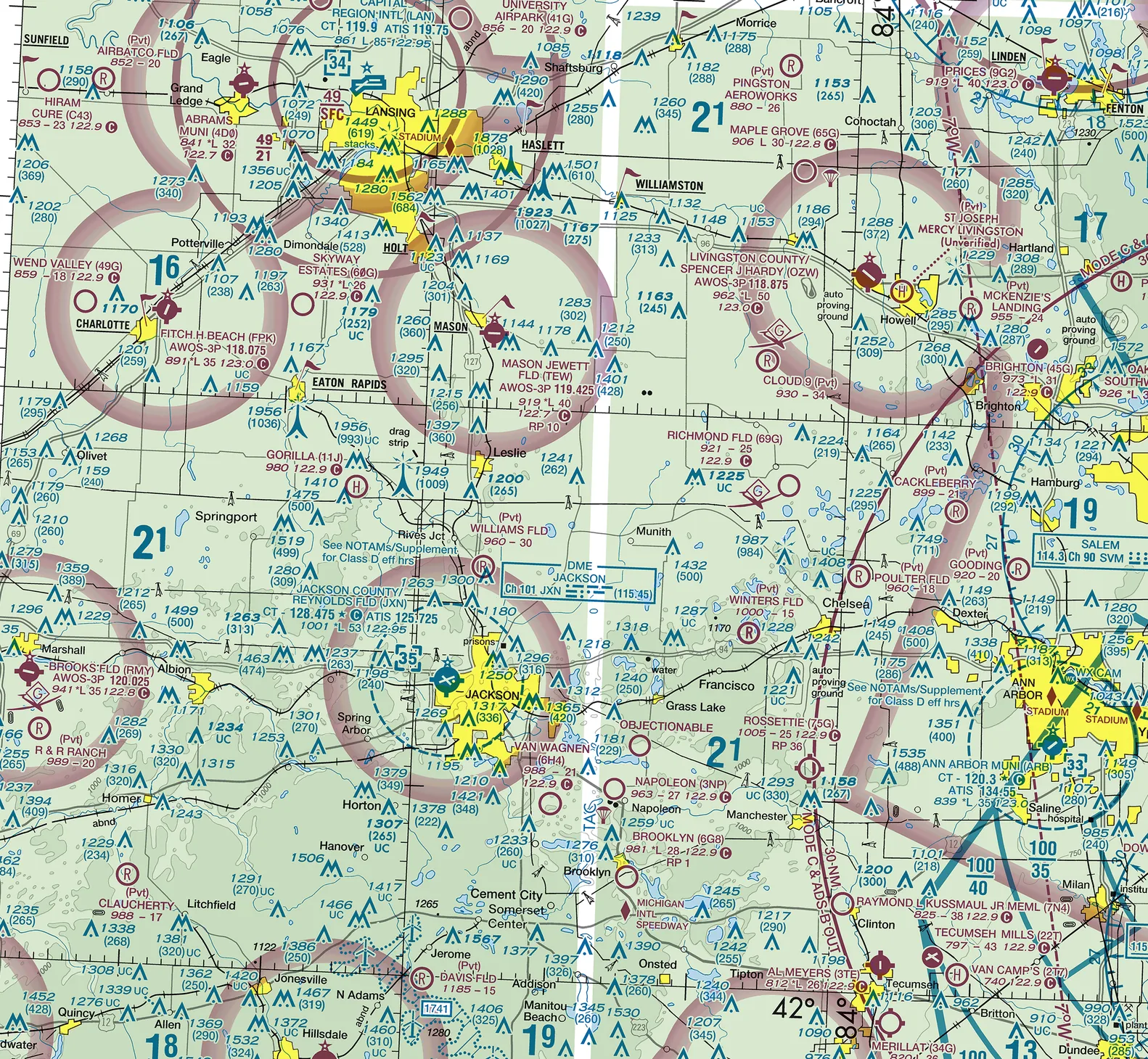
FAA Detroit sectional, 29 OCT 2026 edition. For briefing, not for navigation: fly from the current chart. Tap the chart to open it full size.
Today's flight
A friend wants to go flying with you once you have your certificate: a look at their house near Chelsea from the air, lunch at Jackson (KJXN), and home by mid-afternoon. Today you fly that trip with the instructor as that friend, and every maneuver on the checkride comes up because the trip needs it: a steep turn for a better look, a circle around a point for a photo, slow flight behind slower traffic, a short and a soft field arrival, a slip when you are high, a go-around when the runway is not clear.
This lesson is usually several flights, on different days and in different winds. It is done when every maneuver meets the checkride standard on an ordinary day, not just on a good one.
Every flight
Before every flight
P
Pilot.Am I fit to fly today? IMSAFE:
Illness
Medication
Stress
Alcohol
Fatigue
Emotion, and eating
A
Aircraft.Is this airplane ready, and right for today? Documents, inspections and open squawks; fuel and oil on board; weight, balance and performance for today's load.
V
Environment.What will today's flight meet? NWKRAFT, what 14 CFR 91.103 asks you to know before every flight, then the airspace and the route:
NOTAMs and TFRs
Weather, against your minimums
Known ATC delays
Runway lengths
Alternates
Fuel required, with reserve
Takeoff and landing distances
Airspace: the Class B limits from the current chart
The trip: heading, time, landmarks, wind and runway
E
External pressures.What is pushing me to go today: a passenger, a schedule, a plan I don't want to cancel? Would I go without it?
If it goes wrong.The takeoff emergency brief, out loud: an engine problem on the runway, after liftoff with runway left, and after liftoff without.
Who flies.Who does what today, and how we hand the controls back and forth.
Who runs it today:You, alone and unprompted, then you brief the instructor as your passenger. The instructor checks your planning before the flight, as on your solos.
Deeper today:The trip. Full planning alone: the weather the day before and the morning of, a navigation log, weight and balance with a real passenger's weight, the limits block from the current chart for the departure under the Class B edge, and a diversion the instructor gives you in flight. Who flies also goes deeper: the passenger briefing you would give a friend who has never been in a small airplane. External pressures goes deeper too: a friend waiting for lunch is exactly the pull PAVE's E asks about, so say whether you would still go without it.
Recall
From earlier lessons
What did your long solo cross-country need to meet 14 CFR 61.109(a)(5)(ii)?
Reveal answer
At least 150 NM total, full-stop landings at three points, and one leg with a straight-line distance of more than 50 NM between takeoff and landing.
Where does a short field landing distance come from, and what changes it?
Reveal answer
The performance section of the airplane's handbook. Weight, pressure altitude and temperature (density altitude), wind and the runway surface all change it, and the chart's notes say how.
Why does the stall speed go up in a steep turn?
Reveal answer
Holding altitude in a bank takes more lift, so the load factor goes up, and the stall speed rises with it. Same airplane, same critical angle of attack, higher speed.
When do you use a forward slip?
Reveal answer
To lose altitude without gaining airspeed, usually when you are high on final. Check your airplane's handbook for any caution about slipping with flaps extended.
WhyThe checkride grades you against a written standard, so from today you grade yourself against the same one.
What the standard is
One document, the Private Pilot ACS, lists every task. The tolerances are in its skill elements.
Satisfactory: every task within its standard, with mastery of the airplane and sound judgment.
Unsatisfactory is rarely one number: repeated misses, slow corrections, needing help, poor clearing or risk.
A deviation you catch and fix is flying. One you don't notice is the problem.
WhyThe examiner builds a scenario and the maneuvers come out of it, so practice them the same way.
Maneuvers with a reason
Steep turns: a closer look at the house, or a turn away from traffic, altitude held.
Ground reference: circling a point for a photo, at a height that keeps you legal over houses.
Slow flight: following a slower airplane, or holding back before an approach.
Stalls: the base-to-final turn and the full-flap go-around, met at altitude so they never meet you near the ground.
Spin awareness: you explain it, and you show it by never getting close.
WhyEight of the tasks are takeoffs, landings and go-arounds, and every arrival is graded, not just the one called a maneuver.
Every kind of arrival
Before each one, say which kind it is and why. Speeds and configuration come from the handbook and the club checklist.
Short field: name the touchdown point before you turn base.
Soft field on pavement: fly it as if the surface were soft. The technique is what's graded.
Go-around: a normal decision made early, never a failure.
No crosswind on the day? The examiner asks about it instead.
WhyAfter the checkride nobody grades you, so the habit has to be yours.
Grade yourself first
Say the standard before the maneuver.
Call your deviations as they happen, and fix them promptly: the correction is part of the standard.
After each one: inside the standard or not, and what caused the difference.
The aim by the checkride: perform for every maneuver and manage-decide for every decision.
WhyThe first real use of your certificate is probably a friend in the right seat, and the rules make the briefing your job.
The passenger briefing
The rule: show each person how their belt and harness work, and tell them to fasten up before you move.
SAFETY: Seat belts, Air and how they feel, Fire extinguisher, Exits and the survival kit, Traffic and talking, Your questions.
Tell them when to stay quiet: taxi, takeoff, landing, and whenever you are on the radio.
A passenger can't share the decision. "They came all this way" is a pressure, not a reason.
WhyThe most dangerous part of a passenger's first flight is walking to the airplane.
Getting in and out near the propeller
Walk them to the door yourself, from behind the wing. Nobody walks in front of the airplane.
Treat the propeller as live, engine running or not.
Clear the area and call "clear prop" before you start, and wait until they're seated and belted.
After shutdown, they wait in their seat until the propeller has stopped and you say so.
A real accident
In August 2016 a private pilot was flying a Cessna 172N in the traffic pattern at Terre Haute, Indiana, to evaluate it for purchase, with the owner, also a private pilot, in the right seat. On the first approach the airplane was low and slow on final, and he went around. On the second approach it was again low and slow, hit a 50 ft tree about 1,355 ft short of the runway, and then a house; one person died and one was seriously injured. The NTSB found the probable cause was his failure to keep a normal approach path, with his lack of recent experience contributing: he had not flown in 11 months, had last flown the model more than 2.5 years before, and had not done a flight review in the 4 years since getting his certificate. The first go-around was the right call, and the second approach showed the same picture. The standard you polish here is the one that has to last after the checkride: stable on the approach path or go around, every time, and stay proficient, not just current. NTSB report CEN16FA333
Your calls
Decision points
Is today a polishing day? Wind, ceiling and visibility against your minimums, and whether a windy day should be a crosswind day instead.
On every approach: stabilized by the point you set, or go around.
The diversion the instructor gives you: where, how far, and whether fuel and daylight still work.
Whether each maneuver met the standard. You call it first.
The whole flight
Also on this flight
Part of the flight
Who
Every-flight routine and full trip planning
You, alone; instructor checks it
Passenger briefing, SAFETY, and the walk to the airplane
You, to the instructor as your passenger
Preflight, start, taxi, runup
You
Departure under the Class B edge, limits from the chart
You
Steep turns, ground reference, slow flight, stalls: each until two in a row are inside the standard
You; instructor grades against the ACS
Navigation, diversion
You
Simulated failures, sometimes unannounced
You fly them; instructor sets them up
Short, soft, normal and crosswind takeoffs and landings, slips, go-arounds: at least two of each kind before heading home
You
Radio and tower, at KARB and KJXN
You
Shutdown, securing, squawks
You
Debrief
Both, you first
The standard
Ready to move on when
Every task in Areas IV, V and VII is flown within its ACS standard, without help, more than once and on more than one day.
You say each task's standard before flying it and call your own deviations before the instructor does.
For example, the steep turn standard is entry altitude ±100 ft, airspeed ±10 knots, bank ±5°, and roll out on the entry heading ±10° (FAA-S-ACS-6C, PA.V.A.S5). Read every other task's standard in the ACS itself.
You can explain spin entry, the phases of a spin and the recovery, from the ACS elements and your airplane's handbook.
You give a complete passenger briefing, and get a passenger in and out with the propeller in mind.
You plan and fly the whole trip, including a diversion, with no input from the instructor.
At home, before the next flight
Chair fly it
Read Area I tasks A, B, G and H and Area IX task D in the ACS, the knowledge and risk management elements. Lesson 23 is the oral on them.
Plan a trip with a passenger for lesson 23: your own trip from lesson 2 if your long solo cross-country didn't use it, or one the instructor gives you. Full planning, as if leaving the next morning. Start it now; it's due before lesson 23.
Read the applicant's practical test checklist in section 7 of the ACS Companion Guide for Pilots and start gathering what it lists.
Chair fly the maneuver you graded lowest today, with the club checklist, saying the standard out loud first.
After the flight
Debrief
You go first, then the instructor. Three points at most, and you write down one thing to work on next time.
Which maneuver is checkride-ready today that wasn't last time?
Which maneuver was furthest from its standard today, and what was the first thing that went wrong in it?
Where did the trip itself make a maneuver harder (traffic, wind, the passenger), and how did you handle it?
Before the flight
Plan on several flights. Fly them on different days and in different winds; a crosswind day is a good polishing day.
Training within the 2 calendar months before the month of the test counts toward the 3 hours of 61.109(a)(4). Keep the checkride date in mind when scheduling these flights and log them so the time is easy to find.
Have the ACS open to the tasks you plan to see. Grade from the skill elements, not from memory.
Check the planning before the flight as you would a solo cross-country: weather, navigation log, weight and balance with the passenger's real weight, and the limits block for the departure.
Sources behind the slides: the ACS is the Private Pilot ACS (FAA-S-ACS-6C), and its introduction lists the typical unsatisfactory performance; satisfactory performance, 14 CFR 61.43; minimum altitudes for ground reference, 14 CFR 91.119; crosswind elements tested orally when there's no crosswind, the note in task IV.A; spin awareness has no skill element; the grading scale, Aviation Instructor's Handbook chapter 6; the passenger briefing is ACS task II.B.
The belt rules: the pilot in command must make sure each person is briefed on fastening and unfastening the belt and harness before takeoff, and notified to fasten them before moving on the surface, takeoff and landing (14 CFR 91.107(a)(1) and (2)). The SAFETY briefing is from the FAA's Passenger SAFETY Briefing checklist (FAA Safety Briefing, July/August 2014).
In the air
Let the scenario call the maneuvers: "I'd love a closer look at that house" is a steep turn; "can you circle the barn so I can get a photo" is turns around a point.
Watch the house-circling for 91.119 and for altitude chasing. The student picks the point and the altitude; ask why before you approve it.
Fly each arrival type at least twice before going home, and any maneuver outside the standard again until two in a row are inside it.
Common errors: eyes inside chasing a tolerance instead of clearing; losing altitude on the steep turn rollout; floating past the short field touchdown point; letting the nose down too early on the soft field takeoff; slow flight drifting into the stall warning; forgetting to configure for the go-around in the handbook's order; walking the "passenger" past the propeller.
Curveballs
Unannounced ones are fair now, in safe conditions only: a simulated engine failure only where a landing is possible (ACS Appendix 2), and never close to the ground.
Unannounced: a simulated engine failure over open fields near Chelsea.
Unannounced: "a truck just pulled onto the runway" on short final. Go around.
Briefed: a diversion to an airport they haven't planned for, mid-trip.
Briefed: realistic distractions from the "passenger": a question, a chart that needs folding, a camera in the way.
Briefed: "I'm feeling sick." The student decides between landing now and heading home.
After the flight
Mark the milestone: each task the student flew to the standard for the first time.
The student grades every task first, against the ACS. Compare notes and write down any task not yet at the standard.
Praise the go-around and the turn-back. They are the standard too.
Before lesson 23, look at the student's knowledge test report: the ACS codes for missed questions must be covered before the 61.39(a)(6)(iii) endorsement.