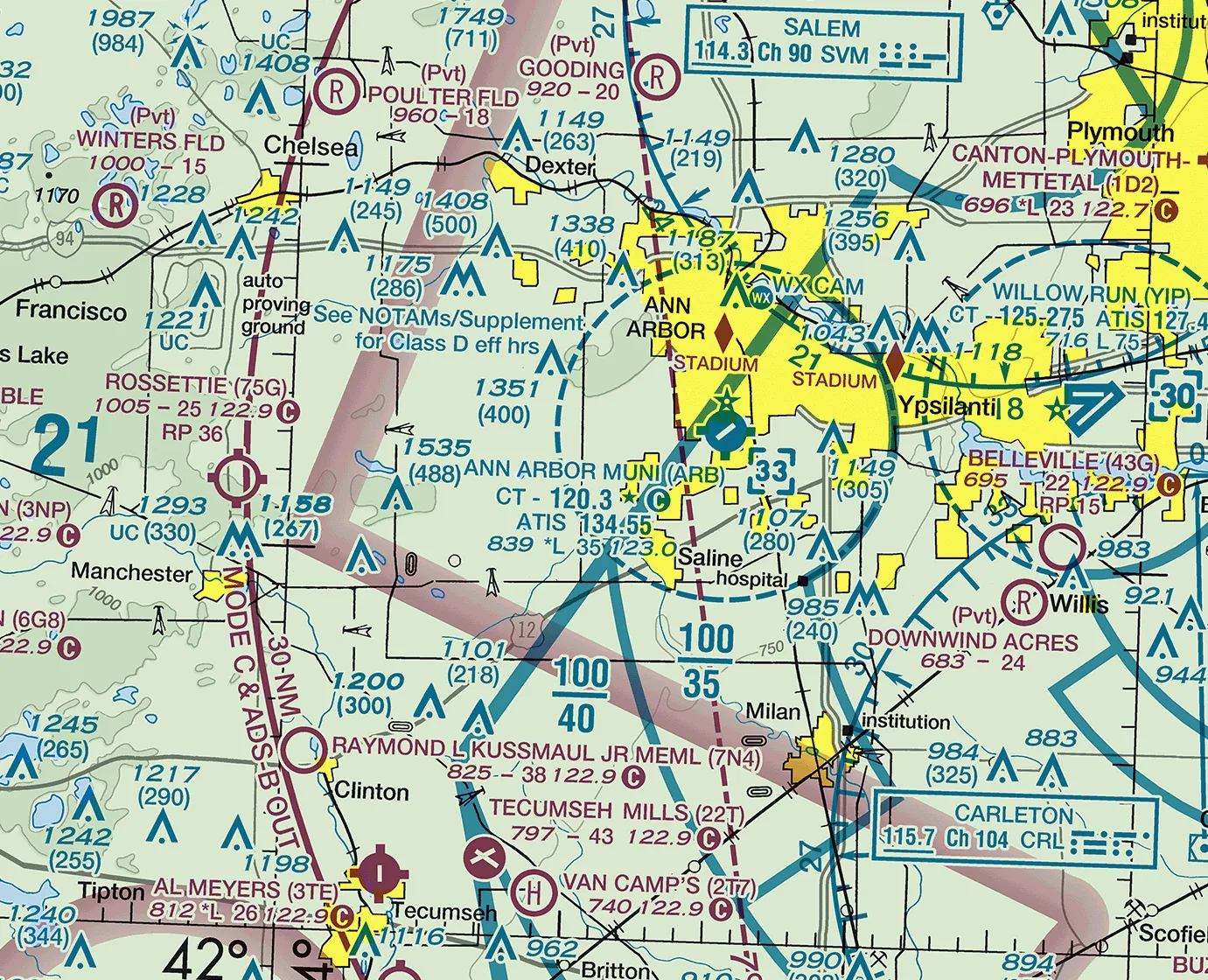
FAA Detroit sectional, 29 OCT 2026 edition. For briefing, not for navigation: fly from the current chart. Tap the chart to open it full size.
Today's flight
How much fuel is in the tanks right now, and how do you know? Today nobody else will ask.
Your first flights alone away from the pattern. Fly out to the practice area around Rossettie (75G) and the Chelsea Proving Grounds, practice the maneuvers we agreed on, and be home by the time you set. It is the same trip you have flown since the discovery flight. What's new is that every decision on it is yours: when to go, what to practice, and above all when to come home. Every trip you named in lesson 2 starts like this one: a time home you set and keep.
First we fly a short dual check together. Then you fly it alone three or four times, and each solo flight adds one new task I give you before you go. These flights build the solo time the checkride needs.
Every flight
Before every flight
P
Pilot.Am I fit to fly today? IMSAFE:
Illness
Medication
Stress
Alcohol
Fatigue
Emotion, and eating
A
Aircraft.Is this airplane ready, and right for today? Documents, inspections and open squawks; fuel and oil on board; weight, balance and performance for today's load.
V
Environment.What will today's flight meet? NWKRAFT, what 14 CFR 91.103 asks you to know before every flight, then the airspace and the route:
NOTAMs and TFRs
Weather, against your minimums
Known ATC delays
Runway lengths
Alternates
Fuel required, with reserve
Takeoff and landing distances
Airspace: the Class B limits from the current chart
The trip: heading, time, landmarks, wind and runway
E
External pressures.What is pushing me to go today: a passenger, a schedule, a plan I don't want to cancel? Would I go without it?
If it goes wrong.The takeoff emergency brief, out loud: an engine problem on the runway, after liftoff with runway left, and after liftoff without.
Who flies.Who does what today, and how we hand the controls back and forth.
Who runs it today:You, alone. I check it, and your navigation log, before I sign the flight off.
Deeper today:The trip and Aircraft. A real navigation log, out and back: true course, wind correction, heading, groundspeed, time, fuel and checkpoints. And fuel you have measured yourself, turned into a latest time home with a reserve.
Recall
From earlier lessons
Where does the Class B end on the way out west, and how high can you go until you're past it?
Reveal answer
Close west and north of KARB, from the current chart. Stay below the floor over the field until you are past the edge.
Clouds are building in the west, lower than forecast. What decides when you turn back?
Reveal answer
The turn-back trigger you set on the ground. When you see it, you go home.
The engine runs rough over the proving grounds. Where can you go?
Reveal answer
Rossettie (75G), back to KARB, or a field: whichever you can reach with margin. Then the club checklist.
You bounce on landing, alone. What do you do?
Reveal answer
Go around.
WhyAway from the pattern nobody is watching, so the limits in your logbook are your instructor in the right seat.
Your limits, out west
Where, how high, which maneuvers and how long: written in your logbook.
Below the Class B floor until you're past the edge.
Above the minimum altitude we set for maneuvers.
No landing at Rossettie or anywhere else, except in an emergency.
WhyIn fuel accidents the fuel runs out long before the engine stops: on the ramp, in the planning.
Fuel and time
Measure the fuel yourself, the way the club checklist says. The gauges are a cross-check.
Turn fuel into time with the handbook, then take off your reserve. That's your latest time home.
Write the time you'll head home on your log, and set a timer.
Anything about the fuel that doesn't match the plan: go home now.
WhyThe habit that carries you on every cross-country starts on a 14 mile trip.
The navigation log
True course from the chart, wind from the forecast, then heading, groundspeed and time.
Two or three checkpoints, and the time you pass each one.
Planned against actual tells you whether the wind is what was forecast.
Plan the way home too: the wind that pushed you out may slow you down coming back.
WhyEnding the flight is the decision that keeps every other one safe.
When to come home
Time: you reach the time you set.
Fuel: anything that surprises you.
Weather: your turn-back trigger from the ground.
You: tired, uneasy, or behind the airplane.
WhyComing home you fly back under the Class B and into a busy Class D, with nobody to help with the radio.
Back to KARB alone
Get the ATIS before you call the tower, and call well outside the Class D.
Stay below the Class B floor once you're back under the shelf.
Plan the pattern entry for the runway in use before you call.
A real accident
On October 8, 2015, a student pilot on his second supervised solo flew a Piper PA-38 to the practice area at Jasper, Georgia, and came back about an hour later. On the climb after a touch-and-go the engine stopped; the airplane turned left as if heading back to the airport, stalled and spun, and the student was killed. The fuel system was empty. He had told his instructor there was about half fuel aboard, and the airplane's log showed it had flown about 4.9 hours since its last refueling, more than its full-tank endurance; the NTSB concluded he most likely measured the fuel wrong. The probable cause was his failure to determine the fuel state, with the instructor's inadequate oversight of the preflight, the school's lack of fueling procedures and the stall as contributing factors. The decision point was on the ramp: a fuel check that agrees with the airplane's log, and a plan that turns fuel into a time to be home. NTSB report ERA16FA005
Your calls
Decision points
Whether to go today, against your limits, including the fuel you measured.
When to come home: time, fuel, weather or how you feel, whichever comes first.
What to do with the unexpected: traffic near 75G, a cloud where you wanted to practice, a rough engine.
The whole flight
Also on this flight
Part of the flight
Who
Dual check before the first solo flight out west: the departure, two maneuvers and the return
You fly; I watch
Every-flight routine and navigation log
You, alone; I check them before I sign the flight off
Preflight, including measuring the fuel
You
Start, taxi, runup, takeoff
You
Departure under the Class B edge to the practice area
You
Solo maneuvers we agreed on, from the list in your logbook, each flown at least twice
You
The new task for this flight, given before you go
You
Return to KARB, pattern and landing
You
Shutdown, securing and logging
You
Debrief after each flight
Both, you first, when you're back
The standard
Ready to move on when
Your navigation log and fuel plan are complete on every flight, and you used them in the air.
You were home by the time you set, every time, with the fuel you planned on.
You stayed inside every limit: area, altitude, maneuvers and time.
You can explain how your planned and actual times compared, and why.
You have flown three or four solo flights out west, each with its new task done.
At home, before the next flight
Chair fly it
Next is the triangle again, and this time you plan it as if you were picking a friend up at KYIP. Plan every leg for real: a navigation log for each, the limits block from the current chart, and the wind and runways at 22T and KYIP.
Read 22T and KYIP in the Chart Supplement again, and note anything that has changed since lesson 10.
For each leg, pick an airport you would divert to, and know which way it is from the route.
Read 14 CFR 61.93(b)(1): what your solo flights to 22T and KYIP will need.
After the flight
Debrief
You go first, then the instructor. Three points at most, and you write down one thing to work on next time.
Your first flight alone away from the pattern: which moment made it feel like yours?
When did you decide to come home, and what decided it?
How did your planned times compare with the actual ones?
Before the flight
Write the practice area limits in the logbook: the area, minimum and maximum altitudes, the maneuvers allowed solo and the latest time home, within the club's limits. The student has no 61.93(b)(1) training or endorsement for 75G, and it is a turf field, so no landing there. Going more than 25 NM from KARB needs cross-country training first (61.93(a)); the practice area is about 13 to 14 NM out.
List the maneuvers with counts, within the club's solo rules, for example: two steep turns each way, slow flight, one ground reference maneuver, power-off stalls only if the club allows them solo, and about 40 minutes in the area.
Fly the dual check first: departure, two maneuvers and the return. If it has been more than a week or two since the last flight, make it longer.
Check the navigation log and the fuel plan, and look at the fuel yourself before each flight. In the Jasper accident the instructor's inadequate oversight of the preflight was a contributing factor.
These flights count toward the 10 hours of solo flight time 14 CFR 61.109(a)(5) requires. Keep a running total.
In the air
You are on the ground. Know the student's time home and what you will do if they are overdue.
Common errors, to look for in the debrief: climbing into the Class B on the way home, losing track of time while practicing, maneuvering low or over a town, and calling the tower without the ATIS.
Curveballs
One per solo flight, given on the ground before the student leaves (on solo there are no surprises from you):
Find and fly over a landmark you haven't been shown, picked from the chart before you leave, and still be home by your time.
Fly home by a different route and checkpoints than you went out by.
Set a time home 15 minutes earlier than the fuel allows, and meet it.
On the way home, get the ATIS, then plan the pattern entry for the other runway in case the tower changes it.
Note planned and actual times at every checkpoint, and work out the real wind from them when you're back.
After the flight
Go over the navigation log: planned against actual, and what the difference says about the wind.
If the student came home late, outside a limit, or without the log used, fly the next one dual.
Mark the first: the first solo away from the pattern.
Ask what the student would change for the triangle plan in lesson 14.