Today's flight
Someday you will fly a friend to Battle Creek (KBTL) for dinner, and by the time you walk back to the airplane the sun will be down. Tonight I am that friend. The airplane is the same, the route is the one you flew on your first dual cross-country, and the airport is the same. What changes is everything you see, and how many options you have if something goes wrong.
This lesson is two or three flights. The first brings the airplane home to KARB after sunset and stays in the pattern. Then you fly the night cross-country: KARB to KBTL and back, over 100 NM in total. Together they give the 3 hours of night training, the night cross-country, and the 10 full-stop night takeoffs and landings that 14 CFR 61.109(a)(2) asks for.
Every flight
Before every flight
- P
Pilot. Am I fit to fly today? IMSAFE: - Illness
- Medication
- Stress
- Alcohol
- Fatigue
- Emotion, and eating
- A
Aircraft. Is this airplane ready, and right for today? Documents, inspections and open squawks; fuel and oil on board; weight, balance and performance for today's load.
- V
Environment. What will today's flight meet? NWKRAFT, what 14 CFR 91.103 asks you to know before every flight, then the airspace and the route: - NOTAMs and TFRs
- Weather, against your minimums
- Known ATC delays
- Runway lengths
- Alternates
- Fuel required, with reserve
- Takeoff and landing distances
- Airspace: the Class B limits from the current chart
- The trip: heading, time, landmarks, wind and runway
- E
External pressures. What is pushing me to go today: a passenger, a schedule, a plan I don't want to cancel? Would I go without it?
-
If it goes wrong. The takeoff emergency brief, out loud: an engine problem on the runway, after liftoff with runway left, and after liftoff without.
-
Who flies. Who does what today, and how we hand the controls back and forth.
Who runs it today: You, unprompted, and you brief the instructor.
Deeper today: Weather, NOTAMs, Aircraft and The trip, for the dark. Weather: your night minimums, the moon, and the temperature and dew point spread, since fog forms as the air cools. NOTAMs: lights out at KARB, KBTL and the airports along the route. Aircraft: every light the rules need and the airplane has, a flashlight, and spares. The trip: a navigation log with the lit airports along the route as your emergency fields, and fuel for the night reserve.
Recall
From earlier lessons
What words mean you may enter the Class B?
Reveal answer
"Cleared" with "Bravo airspace", for example "cleared through Bravo airspace" or "cleared into the Class Bravo airspace". A squawk code, "radar contact" or a heading is not a clearance.
Weather ahead is worse than forecast on a cross-country. How do you decide what to do?
Reveal answer
Against the turn-back trigger you set on the ground. If it is met, divert or turn around, early, while you still have good options.
How much fuel must you have beyond your first landing, on a VFR flight by day?
Reveal answer
Enough to fly 30 more minutes at normal cruise (14 CFR 91.151). At night it is 45 minutes. Your own reserve may be more.
What are the VFR minimums in Class G near the ground by day, and how do they change at night?
Reveal answer
By day, 1 mile and clear of clouds. At night, 3 miles, and 500 ft below, 1,000 ft above and 2,000 ft sideways from clouds (lesson 17).
Why At night what you see depends on how you use your eyes.
Your eyes at night
- Dark adaptation takes up to 30 minutes, and a bright light undoes it in a second. Keep the panel lights low.
- Look straight at a dim light and it can fade away. Look a little to one side of it.
- Scan in small steps. A light that seems to drift while you stare at it may not be moving at all.
- Fatigue and anything that cuts oxygen to the eyes make it worse.
Why On the ground at night the airport is a field of colored lights, and plenty of night mistakes happen before takeoff.
Taxiing in the dark
- Taxi slowly: distances are hard to judge, and the taxiway edge is a row of blue lights.
- Have the airport diagram out, and say each turn before you make it.
- Taxi light on when you move, off when you stop or give way. Strobes off if they dazzle others.
- Stop at every hold short line, and check the runway both ways. All lights on to cross it.
Why At night, lights are how you see other airplanes, how they see you, and how you find the runway.
Lights: theirs, yours, the airport's
- Red on the left wingtip, green on the right, white on the tail.
- See red on the left and green on the right: it's going your way. The other way round: it may be coming at you.
- The airport beacon flashes white and green. Runway edges are white, taxiway edges blue.
- Pilot-controlled lighting: key the mike on the right frequency, 7 times in 5 seconds for full brightness.
Why On a dark night the runway lights can be the only thing you see, and they can lie about how high and how far you are.
Illusions on the way down
- Black hole: over unlit ground the pull is to fly lower than normal. That ends in the trees.
- Bright runway lights with little around them can make you feel low, so you fly high.
- Fly the same pattern at the same altitudes as by day, and cross-check the altimeter. Use the PAPI or VASI.
- Not sure where you are relative to the runway? Go around.
Why The rules use three different "nights", and each starts at a different time.
The rules after dark
- Position lights: sunset to sunrise.
- Logging night, and the night training for the certificate: civil twilight to civil twilight.
- Passengers at night, once you're a private pilot: 3 full-stop landings in 90 days, an hour after sunset or later.
- Fuel: 45 minutes beyond your first landing at night.
Why At night you can't see clouds, the ground or a good field, so the plan has to carry what your eyes can't.
Planning for fewer options
- The route is the one from lesson 17; heading, time and fuel are yours for tonight's wind.
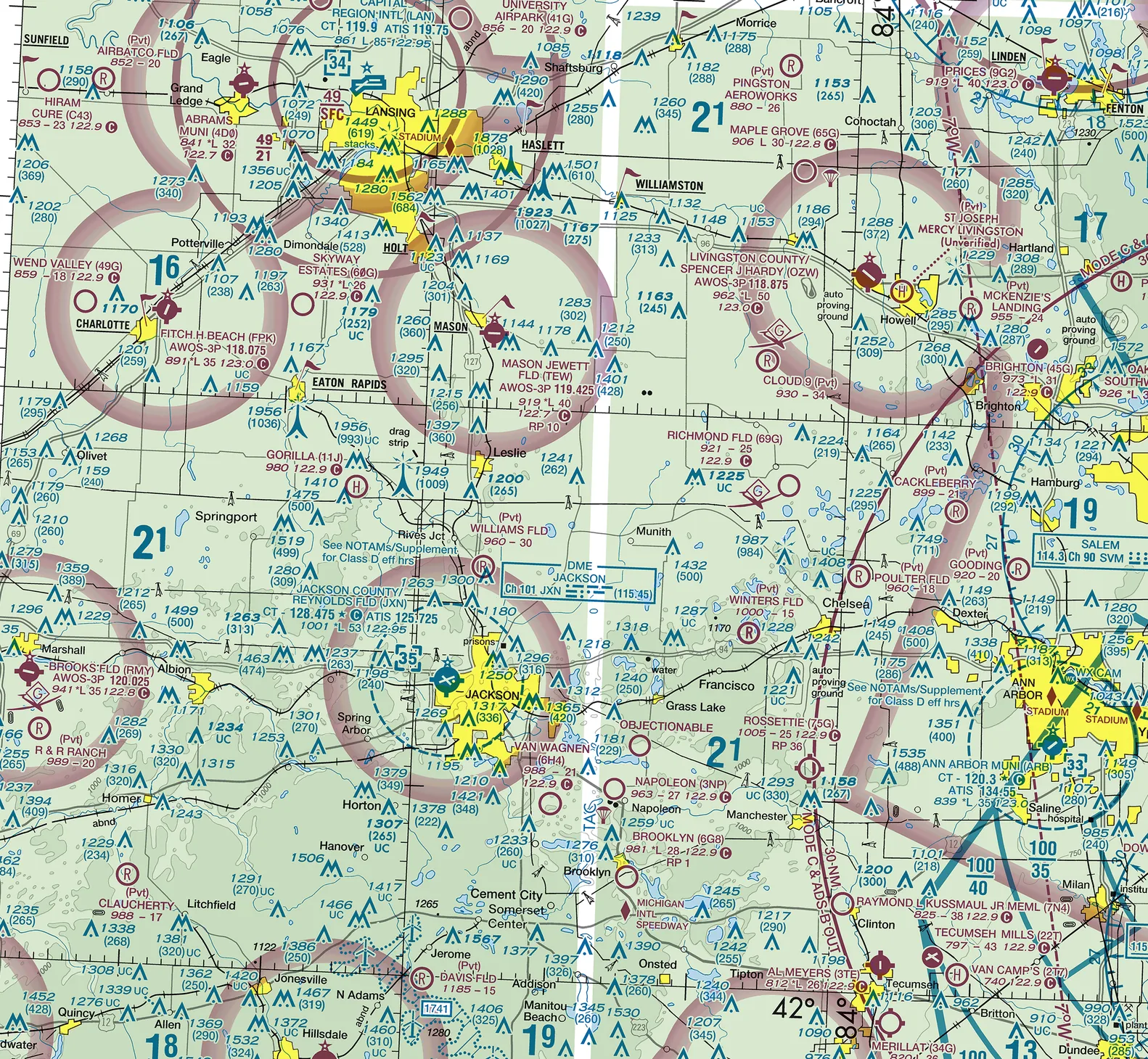
- Jackson (KJXN) is almost on the line. Know its tower hours, and whether you'll talk to it, go around it or land.
- List the lit airports along the route, and know which way each one is at every checkpoint.
- Higher gives you more glide range and more room above towers. Read the obstructions on the chart.
Why The things that go wrong at night are the same as by day, and you have fewer clues to deal with them.
When it goes wrong in the dark
- Electrical failure: the engine keeps running. Flashlight, spare, and a chart you can read in red light.
- Engine failure: best glide toward a lit airport or away from houses, then the checklist and a call.
- A light out on the preflight: check the rules and the club's before deciding.
- Unsure of the weather ahead: you won't see the cloud until you are in it. Turn back earlier than by day.
A real accident
On December 5, 2002, at 7:45 in the evening, a private pilot with about 250 hours was flying a rented Cessna 172M around the traffic pattern for runway 31 at Quad City International Airport in Moline, Illinois, on a clear dark night. Turning from base to final, he saw something out of his right eye and felt a bump, added full power, and landed. The right wing's leading edge was crushed, with debris consistent with a tree strike. The NTSB's probable cause was the pilot's failure to maintain altitude clearance during the base to final turn, with the night conditions and the trees as factors. By day the trees would have been plain to see; at night the only defense is to fly the pattern at its normal altitudes, stay on the PAPI or VASI, cross-check the altimeter, and go around when in doubt. NTSB report CHI03LA040
Your calls
Decision points
- Your night minimums, set before the flight: ceiling, visibility, wind and the moon, and how they differ from your day minimums.
- Go or no-go for the cross-country, with the temperature and dew point spread closing and haze in the forecast.
- A light out on the preflight: fly, fix, or cancel.
- In flight, ground lights ahead start to disappear: continue, divert to a lit airport, or turn back.
The whole flight
Also on this flight
| Part of the flight | Who |
|---|
| Every-flight routine, for the dark | You, unprompted; you brief the instructor |
| Navigation log, lit airports along the route, fuel with night reserve | You; the instructor checks |
| Preflight with a flashlight | You |
| Start, taxi with lights, runup | You |
| Night takeoffs and landings: at least 10 to a full stop over the flights, the last three on the glide path without help | You |
| At least two landings without the landing light | You |
| Pilot-controlled lighting, if the tower is closed | You |
| Night cross-country to KBTL and back | You |
| Simulated electrical failure, landing light off | You fly; the instructor briefs it before the flight |
| Pattern and landing home at KARB | You |
| Debrief | Both, you first |
The standard
Ready to move on when
- You have logged the 3 hours of night training, the night cross-country over 100 NM total, and 10 full-stop night takeoffs and landings, each with a flight in the pattern (61.109(a)(2)).
- Your night approaches stay on the normal glide path and you go around when you are not sure, without being told.
- You taxi at night without a wrong turn, stopping at every hold short line.
- You land without the landing light, and you handle a simulated electrical failure with the flashlight and the checklist.
- You can explain the knowledge and risk elements of ACS XI.A: vision, lighting, equipment, illusions, night currency versus proficiency, and night weather.
- You can say the three "nights" in the rules, what each one is for, and the equipment VFR at night needs.
At home, before the next flight
Chair fly it
- Read the club's Pre-Solo Cross-country Phase Check form: it is what the check instructor grades you on before your first solo cross-country.
- Read 14 CFR 61.93(c) and (d): the endorsements you need for each solo cross-country, and what the instructor must check before signing.
- Read KFPK's listing in the Chart Supplement, including the remarks, and chair fly the departure from KARB, the first two checkpoints, and the calls at a field with no tower.
- Plan the first solo cross-country, to Charlotte (KFPK), as if you were leaving tomorrow: weather, NOTAMs, the navigation log, fuel, weight and balance, and the limits block for leaving and coming back under the Class B edge. Start it now; it's due before lesson 21.
After the flight
Debrief
You go first, then the instructor. Three points at most, and you write down one thing to work on next time.
- Your first night landing: what did short final look like compared with the day?
- On which approach did you feel high or low, and what told you the truth?
- What would make you cancel a night flight that you would fly by day, and would you fly your lesson 2 trip home after dark?
Before the flight
- Pick a clear night with a good forecast for the first one, and plan the timing from the end of civil twilight so the landings count.
- Check the airplane's lights and the student's flashlight on the ground. Brief every failure before engine start: electrical failure, the landing light off, a dark cockpit.
- Check the tower hours at KARB and KBTL against the planned times, so the student knows whether to expect a tower or pilot-controlled lighting.
- Look at the night currency the student will need as a private pilot; this is where they learn why proficiency matters more than the minimum.
- The route: KARB to KBTL is 67.0 NM, 275 degrees true and 094 back (great circle from the FAA's airport coordinates, NASR data effective 29 October 2026). KBTL has right traffic on two runways when the tower is closed; lesson 17's notes list the details.
- Sources behind the slides: dark adaptation, the night blind spot and autokinesis, AFH chapter 11 and AIM chapter 8, section 1; beacons, lighting and pilot-controlled lighting (7 clicks in 5 seconds high, 5 medium, 3 low), AIM chapter 2, section 1; taxi, strobe and runway-crossing light use, AIM 4-3-23.
- The rules: position and anticollision lights, 14 CFR 91.209; night for logging, end of evening civil twilight to beginning of morning civil twilight, 14 CFR 1.1; passenger currency, three takeoffs and three full-stop landings between an hour after sunset and an hour before sunrise in the preceding 90 days, same category and class, 14 CFR 61.57(b); night VFR equipment (position lights, anticollision lights, a source of electrical power, spare fuses if fused), 14 CFR 91.205(c); the night reserve, 91.151.
- The current Chart Supplement says KARB's runway lights, REIL and approach slope lights come on by pilot-controlled lighting on the CTAF when the tower is closed. Have the student find it, and KBTL's, in the current edition.
- The handbook's advice on a night engine failure is to plan the landing on unlit ground if you know it is suitable, with the landing light on in time.
In the air
- Taxi slowly at first; night taxi errors are common and runway incursions are an ACS risk item here.
- Common errors: descending early on base over dark ground, staring at the runway lights instead of scanning, bright panel lights, losing the airport among the city lights, and flaring too high without the landing light.
- On the cross-country, ask "which lit airport would you glide to?" at each checkpoint.
- Point out traffic by its position lights and let the student say which way it is going.
- If the landings stay hard or the student loses the airport in the city lights, stay in the pattern for more full-stop landings before flying the cross-country.
Curveballs
Night stays briefed: every failure is named before engine start, even after solo.
- Briefed: the landing light "fails" on downwind. The student lands without it.
- Briefed: a simulated electrical failure on the cross-country. Flashlight, checklist, and a call on the handheld if there is one.
- Briefed: "Which lit airport now?" at an unexpected moment, and the student turns toward it.
- Briefed: a tower closing as you arrive at KBTL, so the student switches to the CTAF and pilot-controlled lighting.
After the flight
- Mark the first: the first night landing, and the first night cross-country.
- Count the night takeoffs and landings with the student and log them as night, separately from the night cross-country.
- Turn what they flew into night personal minimums, written down.
- Night solo is not part of this course; it would need the training and endorsement in 14 CFR 61.87(o).