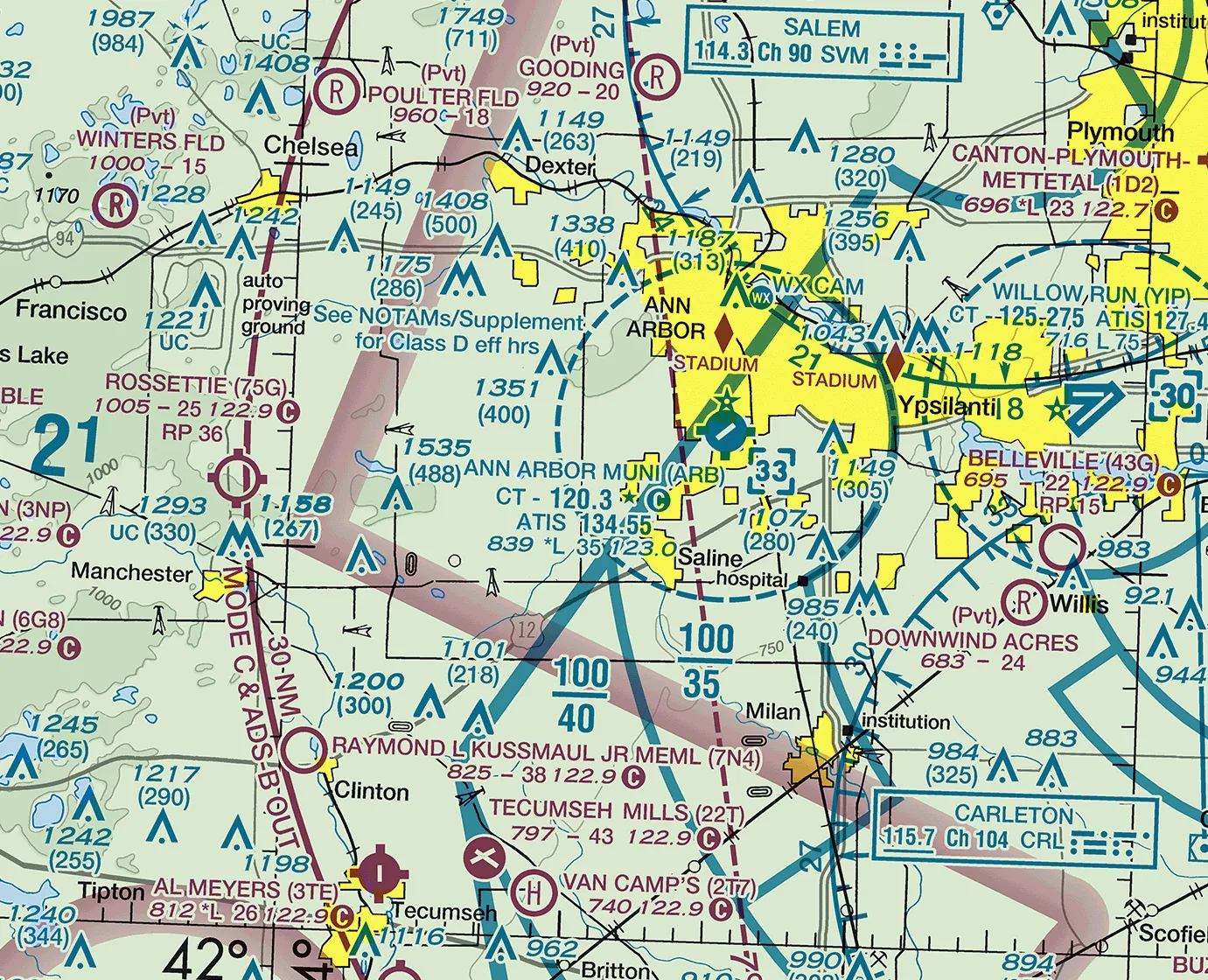
FAA Detroit sectional, 29 OCT 2026 edition. For briefing, not for navigation: fly from the current chart. Tap the chart to open it full size.
Today's flight
You booked the airplane for 9 a.m., to be out west over Pleasant Lake before the afternoon wind picks up. The night before, you open it in SkyManager and find an open squawk. At the club, the activity sheet shows the last renter didn't refuel, and the tanks look low. The clock is running on your morning.
Two questions before anyone starts the engine. Is it airworthy: legal and safe to fly, with that squawk? And is it ready: enough fuel and oil, nothing the walkaround turns up, everything you need on board? You answer both, with your reasons. Then you fly out west and back, and you put the airplane away so the next pilot finds it ready. This is the check you will run the morning of your own trip.
Every flight
Before every flight
P
Pilot.Am I fit to fly today? IMSAFE:
Illness
Medication
Stress
Alcohol
Fatigue
Emotion, and eating
A
Aircraft.Is this airplane ready, and right for today? Documents, inspections and open squawks; fuel and oil on board; weight, balance and performance for today's load.
V
Environment.What will today's flight meet? NWKRAFT, what 14 CFR 91.103 asks you to know before every flight, then the airspace and the route:
NOTAMs and TFRs
Weather, against your minimums
Known ATC delays
Runway lengths
Alternates
Fuel required, with reserve
Takeoff and landing distances
Airspace: the Class B limits from the current chart
The trip: heading, time, landmarks, wind and runway
E
External pressures.What is pushing me to go today: a passenger, a schedule, a plan I don't want to cancel? Would I go without it?
If it goes wrong.The takeoff emergency brief, out loud: an engine problem on the runway, after liftoff with runway left, and after liftoff without.
Who flies.Who does what today, and how we hand the controls back and forth.
Who runs it today:You, with the instructor's prompts. This is the first time you run it yourself.
Deeper today:Aircraft. Documents, inspections, open squawks, fuel and oil, each checked and each said out loud with where you found it. External pressures too: the 9 a.m. plan is pushing you, so say whether you would go without it. The trip is yours for the first time: a rough heading to the practice area, about how long it takes, two or three landmarks you picked from the chart, where the Class B ends, and the wind and the runway it means. The instructor checks it.
Recall
From earlier lessons
Who is pilot in command on a dual flight, and why?
Reveal answer
The instructor. A student pilot may not act as pilot in command of an aircraft carrying a passenger (61.89(a)(1)), and on a dual flight the instructor would be that passenger. You still make the calls; the instructor holds a veto.
Where do the numbers for your airplane live?
Reveal answer
In its handbook (POH) and the club checklist, both linked from the airplane's page on the club's aircraft list. Never on these pages.
You had a glass of wine at 10 p.m. Can you fly at 7 the next morning?
Reveal answer
No. 14 CFR 91.17 says nothing to drink in the 8 hours before you fly, and even after 8 hours you must be below 0.04 and not impaired.
What does the every-flight routine spell, and what is inside it?
Reveal answer
PAVE: Pilot (IMSAFE), Aircraft, Environment (NWKRAFT, then the airspace and the trip) and External pressures. Then the takeoff emergency brief and who flies.
WhyThe pilot in command decides whether the airplane is in condition for safe flight, and that decision starts with paperwork you can check in a minute.
Is it airworthy?
The pilot in command decides the airplane is safe to fly.
On board: the airworthiness certificate, the registration, and the handbook.
Inspections: the annual, the 100-hour, and the ELT and transponder checks.
The club keeps the records. Ask where to see the inspection status.
WhyA squawk is the last pilot telling you something; your job is to decide what it means for today's flight.
The open squawk
Read it the night before, in SkyManager.
Required for today's flight? Then the airplane doesn't go.
Not required: deactivated, placarded "Inoperative", and judged not a hazard.
Not sure? It doesn't go until the instructor or maintenance says so. That is a good call.
WhyEvery item on the preflight checklist is part of a system, and knowing what it does tells you what "wrong" looks like.
The walkaround is a systems lesson
Fuel: tanks in the wings, vents that let air in, drains to sample.
Engine: oil level, leaks, air intake, belt, propeller.
Carburetor or fuel injection? Your handbook says, and it changes the checklist.
The club's rules: refuel, clean the bugs off, activity sheet, SkyManager check in, key back.
Anything wrong goes in SkyManager as a discrepancy, in detail.
Lock up, close the gate behind you, and report anyone who doesn't belong.
A real accident
In March 2015, the pilot of a Cessna 150 at Flushing, Michigan, found water in the fuel during the preflight. He drained about a quart each from the right wing, the left wing, the belly drain and the engine strainer, thought he had removed it all, and ran the engine for five minutes at runup power. He took off, and at about 400 feet the engine lost power; the forced landing went through trees and the airplane was substantially damaged. The NTSB found the probable cause was loss of engine power due to fuel contamination, with the pilot's inadequate preflight as a factor. The decision point was on the ramp: that much water meant the airplane was not ready, and a runup that sounds normal doesn't prove the fuel is clean. Today you sample every drain, and if water keeps coming, the airplane stays on the ground and the squawk goes in SkyManager. NTSB report GAA15CA020
Your calls
Decision points
The open squawk: is the item required for this flight, and if not, is it deactivated and placarded? Go, or a different airplane?
The low tanks: how much fuel this flight needs with the club's reserve, and refueling before you go, even if it costs you the 9 a.m. start.
Anything the walkaround finds (water in a sample, low oil, frost, damage): fix it, squawk it, or both.
After start and in the runup: oil pressure that won't rise, or a magneto drop out of limits. Shut down, or go?
The whole flight
Also on this flight
Part of the flight
Who
Every-flight routine
You, with prompts
Squawk list, documents and fuel decision
You decide; the instructor checks
Preflight inspection
You, once through, explaining each item's system out loud; the instructor watches and asks
Refueling
You, with the instructor
Engine start
You, with the instructor
Taxi
You, the whole way out and back; the instructor talks on the radio
Runup
You: every item said out loud with what it checks
Takeoff and climb
Instructor; you follow on the controls
Out to the practice area and back
You fly: the trip only, no airwork yet
Back to KARB, pattern and landing
Instructor
After landing, parking and securing
You: the whole sequence, without a prompt by the end
Refueling, activity sheet, check in, squawks
You
Debrief
Both, you first
The standard
Ready to move on when
You can say which documents and inspections make the airplane airworthy and where you checked each one (91.7, 91.203, 91.9, 91.409, 91.207, 91.413, 91.417), in the spirit of ACS task I.B.
You can decide what an open squawk means for today's flight, with a reason from 91.205(b) or 91.213(d).
You do the preflight with the club checklist, explaining each item's system as you go, including which instruments the pitot tube, static port and vacuum pump feed, with the instructor only asking questions (ACS I.G and II.A).
You can say what you would do about frost on the wings, a hard or flooded start, a fire during start, and oil pressure that doesn't rise.
You start, taxi and run up with the checklist, saying what each runup item checks, keeping the cabin organized and eyes outside while moving (II.B, II.C, II.D, II.F).
You put the airplane away and lock up to the club's rules without being reminded of a step (XII.A).
The fuel rule is 91.151. The standards are in the Private Pilot ACS; today is about doing them with prompts, not perfectly.
At home, before the next flight
Chair fly it
In Basic Flight Maneuvers (Airplane Flying Handbook, chapter 3), read these sections: The Four Fundamentals, Straight-and-Level Flight, Trim Control, Level Turns, Climbs and Climbing Turns, and Descents and Descending Turns.
In Aerodynamics of Flight (Pilot's Handbook of Aeronautical Knowledge), read the opening section, Forces Acting on the Aircraft.
On the current Detroit sectional or terminal area chart, find KARB, Rossettie (75G) and the Chelsea Proving Grounds, and read the Class B floor over KARB and where the edge is to the west. Bring the numbers; you fill in the limits block next time.
Sit in a chair with the checklist and fly a level-off: climbing, ease the nose to the level picture, let the speed build, set cruise power, trim. Say each step out loud.
Before lesson 4, check the squawks and the weather for your booked airplane.
After the flight
Debrief
You go first, then the instructor. Three points at most, and you write down one thing to work on next time.
Your first time deciding an airplane was ready to fly: what did the squawk and the fuel tell you, and how did you decide?
Which system on the walkaround do you understand least?
What will you check at home the night before next time?
Before the flight
Pick or set up a real decision: an airplane with an open but non-required squawk, a placard, or tanks the student must refuel. Brief it as a finding, not a trick: before solo every surprise is briefed.
Leave time: the first student-run preflight, refuel and securing take much longer than yours. Plan about 0.7 hours of flight. If refueling eats the block, the flight is just out west and back, and that's fine: the lesson is done when the ground parts are.
Know where the club shows inspection and airworthiness directive status for the airplane, so the student can see it, not just hear about it.
Brief at the airplane, not the table: Pitot, static and vacuum during the walkaround, Starting the engine before you start it, Taxi and runup at the runup area. A Michigan winter morning is for cold days only.
Background for questions: 91.7 (the pilot in command decides airworthiness), 91.203 and 91.9 (documents and the handbook on board; weight and balance is part of the handbook), 91.409 (annual within the preceding 12 calendar months, and a 100-hour when used for hire as the rule describes), 91.207 and 91.413 (ELT and transponder), 91.417 (the owner keeps the records), 91.205(b) and 91.213(d) (required equipment and inoperative items), 91.151 (30 minutes by day, 45 at night). The club's operating rules warn that critical airworthiness items may be in the squawk list, and that telling a mechanic isn't enough: it goes in SkyManager.
Systems background: the Airplane Flying Handbook, chapter 2 covers the walkaround (including ice and snow in the spinner), "clear", oil pressure after start, starter limits and preheat. The PHAK's Weather Theory chapter, under Dew and Frost, says frost can drastically reduce lift and must be removed before flight. The Flight Instruments chapter covers the pitot-static and vacuum systems.
Airport security: show the student the club's gate and key rules, and where to report something odd at KARB.
In the air
No airwork today beyond what the trip needs: the four fundamentals are the next lesson.
Let the student taxi with your feet near the pedals. Watch for riding the brakes, taxiing too fast, and heads down in the cabin while moving.
On the runup, watch for skipped items when something new comes up. Ask "what does the checklist say next?" and "what is that item checking?" instead of reading it for them.
Curveballs
All briefed before the flight: before solo nothing is a surprise.
A non-required item placarded inoperative: the student finds the placard and decides.
A document to find: "Show me the registration and the weight and balance."
Low tanks and a 9 a.m. clock: the student works out the fuel and refuels, even if the start slips.
In the runup, you name a magneto drop out of limits ("pretend it dropped too far"): the student says what happens next.
In winter: a light frost on the wings, and the student decides how to get it off or whether to wait.
After the flight
Have the student do the whole securing sequence, including the activity sheet and the SkyManager check in. Ask what they would write as a squawk if anything looked wrong.
Common errors: trusting the fuel gauges, sampling only one drain, not reading the squawk list at all, adding oil without checking the handbook's guidance, and saying "clear prop" without waiting for an answer.
In the debrief, praise a conservative call if they made one (a different airplane, waiting for fuel or maintenance). End on something they did well.