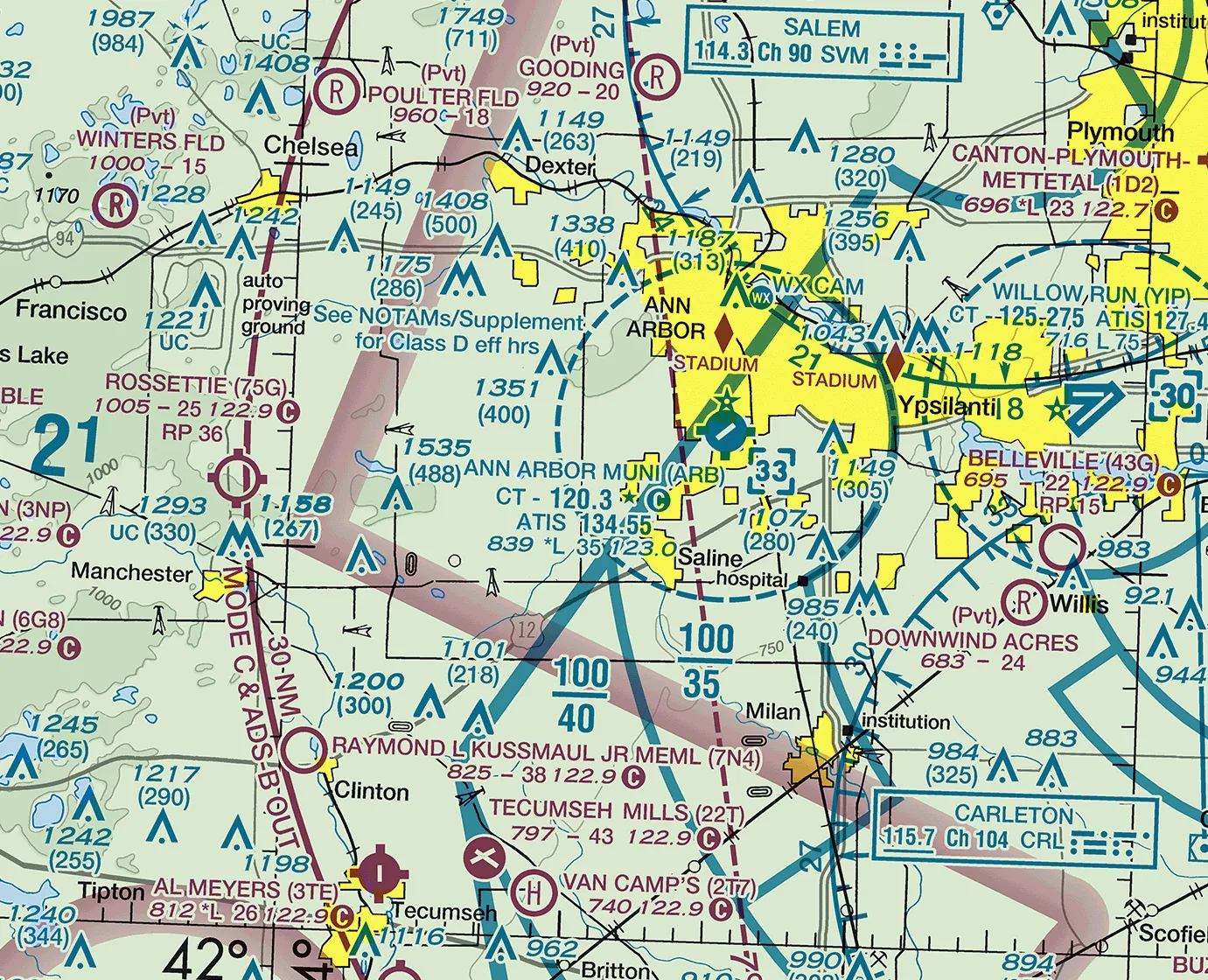
FAA Detroit sectional, 29 OCT 2026 edition. For briefing, not for navigation: fly from the current chart. Tap the chart to open it full size.
Today's flight
The friend you circled the proving grounds for is meeting you at the club for lunch. You fly a short loop out to Pleasant Lake first, and when you left the wind was nearly down the runway. On the way back the ATIS has it well across runway 24, stronger and gusting. Which runway will you ask for? Can you land on it? And if you can't, where is plan B? Lunch waits either way.
You work it out before you enter the pattern, then stay in the pattern for crosswind takeoffs and landings, and learn the forward slip: the way to lose height without gaining speed. Every trip you named in lesson 2 ends at a runway where you don't get to pick the wind. This takes two flights, so the second can be a different wind.
Every flight
Before every flight
P
Pilot.Am I fit to fly today? IMSAFE:
Illness
Medication
Stress
Alcohol
Fatigue
Emotion, and eating
A
Aircraft.Is this airplane ready, and right for today? Documents, inspections and open squawks; fuel and oil on board; weight, balance and performance for today's load.
V
Environment.What will today's flight meet? NWKRAFT, what 14 CFR 91.103 asks you to know before every flight, then the airspace and the route:
NOTAMs and TFRs
Weather, against your minimums
Known ATC delays
Runway lengths
Alternates
Fuel required, with reserve
Takeoff and landing distances
Airspace: the Class B limits from the current chart
The trip: heading, time, landmarks, wind and runway
E
External pressures.What is pushing me to go today: a passenger, a schedule, a plan I don't want to cancel? Would I go without it?
If it goes wrong.The takeoff emergency brief, out loud: an engine problem on the runway, after liftoff with runway left, and after liftoff without.
Who flies.Who does what today, and how we hand the controls back and forth.
Who runs it today:You, with the instructor's prompts.
Deeper today:Weather and The trip. Work out the crosswind component for each KARB runway from the wind in the report, gusts included, and compare it with your own limit (what you have flown well with the instructor) and the handbook's demonstrated crosswind. Then name plan B: another runway, or an airport west of KARB with a runway more into the wind, found on the chart.
Recall
From earlier lessons
On a rectangular course, the wind is from your left on one leg. How do you hold the track?
Reveal answer
Turn a little left, into the wind, and hold that crab so the track stays parallel to the edge of the field.
The tower clears you to land on a runway with more crosswind than you can handle. What do you say?
Reveal answer
"Unable," and what you want instead: another runway, or to leave the pattern. You don't have to accept a clearance you can't fly safely.
When do you go around?
Reveal answer
When the approach isn't on speed, on path and lined up by your gate, the runway isn't clear, you lose the traffic you are following, the tower says so, or anything feels wrong.
What is a cross-controlled stall, and where does it happen?
Reveal answer
A stall with rudder pushing one way and aileron the other, most often in a skidding turn from base to final. One wing drops sharply, and it can become a spin.
WhyPicking the runway is the biggest crosswind correction you will ever make, and you make it before you enter the pattern.
Which runway
Crosswind component: the part of the wind blowing across the runway. Use the chart in your handbook.
Gusts: work it out with the gust, not the steady wind.
Demonstrated crosswind: what test pilots showed. It isn't a limit, and it isn't your limit.
Your limit: the most you have flown well with me.
Plan B: the other runway, or another airport with a runway into the wind. "Request runway 06" is a normal call.
WhyIn the last 500 feet a gust or a shear can take airspeed away just when you have the least height to spare.
Gusts and windshear
The signs: the airspeed jumping around, sink or float you didn't ask for, big power changes to hold the path.
On a gusty day, add part of the gust to your approach speed, so a lull doesn't leave you slow.
Hold the speed with pitch and power, and don't chase every bump.
Not settled by your gate: go around early, while you still have height.
Expect it in gusty wind, in wind over trees and hangars, and near storms. Stay away from storms.
WhyFrom the moment you start rolling, the wind tries to lift the upwind wing and turn the nose into the wind.
Crosswind takeoff
Ailerons full into the wind as you start the roll, less as you speed up.
Rudder keeps the nose on the centerline the whole way.
A clean, positive liftoff, so you don't skip sideways.
After liftoff, crab to track the extended centerline, like the rectangular course.
WhyTouching down while drifting sideways loads the landing gear sideways and can pull you off the runway.
Crosswind landing
On final, crab to track the centerline.
Before touchdown, change to wing low: aileron into the wind, opposite rudder to line up the nose.
Upwind wheel first, then the other, then the nose, and keep the aileron in all the way to the tie-down.
Flaps: in a strong crosswind, check what your handbook says about using less.
Full controls and still drifting: go around and go to plan B.
WhyA slip loses height fast without picking up speed, which saves an approach that is too high.
The forward slip
Aileron one way, opposite rudder, nose off to the side, tracking straight down final.
In a crosswind, slip with the upwind wing low, so it flows into the landing.
The airspeed indicator can read wrong in a slip. Fly the attitude and the sound.
Straighten out smoothly before the flare.
With flaps out, do what your handbook says about slips.
A real accident
On April 2, 2004, a student pilot on his second solo was flying touch and goes on runway 35 at Kalamazoo, Michigan, in a Cessna 172R. His school set his solo crosswind limit at 5 knots. With the wind from 340 degrees at 13 knots, the tower changed the runway in use to runway 05. On his first landing there he felt the left wing lift and the airplane rolled on one main wheel and the nose wheel; he regained control, took off, and asked for a full stop. On that landing, crabbing on final with 30 degrees of flaps, the wind caught the wing and the airplane veered off the runway, hitting runway lights and a sign. He was not hurt; the airplane was substantially damaged. The NTSB cited the controller for not following the procedure that calls for the runway most nearly into the wind, and the student's inadequate correction for the wind, his low experience and his flap setting, with the crosswind as a factor, and noted that a pilot who prefers a different runway is expected to tell ATC, which he did not. There were two places to say "unable, request runway 35": when the tower changed runways, and after the first scare. NTSB report CHI04LA097
Your calls
Decision points
Before you enter the pattern: which runway, from the ATIS and your crosswind numbers, and what plan B is.
The tower assigns a runway with more crosswind than your limit: accept it, or "unable" and ask for another.
On short final, drift you can't stop or an airspeed that won't settle: go around.
After a scary landing: one more, a full stop, or plan B. The instructor may ask for the crosswind runway on purpose to make these real.
The whole flight
Also on this flight
Part of the flight
Who
Every-flight routine, with the crosswind numbers and plan B
You, with the instructor's prompts
Preflight, start, taxi, runup
You
Out to Pleasant Lake and back, ATIS on the way in
You
Radio calls and runway requests
You
Crosswind takeoffs and climbs
You
Pattern and spacing
You
Crosswind approaches and landings: at least six, until two in a row with no help
You; the instructor helps only when needed
Forward slips to a landing: at least three, the last two straightened out before the flare
You
Go-arounds: at least one, plus any time the drift or the speed won't settle
You
One simulated failure, briefed before the flight
You fly; the instructor sets it up
Shutdown and securing
You
Debrief
Both, you first
The standard
Ready to move on when
Before you enter the pattern, you have worked out the crosswind for each KARB runway, chosen one, and can say plan B.
Your crosswind takeoffs stay on the centerline with the right aileron input from start to liftoff.
Your crosswind landings touch down with no side drift and the nose lined up with the runway, two in a row, on the crosswind you flew today, without the instructor's hands on the controls.
On a gusty approach you add part of the gust factor, hold the speed, and go around early when it won't settle.
You fly a forward slip to a landing and straighten out smoothly before the flare. By the checkride the ACS asks for touchdown on, or within 400 ft beyond, a chosen point (task IV.M).
Your personal crosswind limit is written down: the largest crosswind you have flown well with the instructor.
At home, before the next flight
Chair fly it
Find 22T and KYIP on the current chart, and look up their symbols in the chart legend: what tells you one has a tower and the other doesn't.
Fill in a limits block for each leg of the triangle: the Class B floor above you, the highest you will fly, and where you turn back. Find where the Class B reaches the surface east of KYIP.
Read the Chart Supplement listings for 22T and KYIP: runways, pattern directions, frequencies, and KYIP's tower hours.
Read AIM 4-1-9, traffic advisory practices at airports without an operating control tower, and say the 22T arrival and departure calls out loud.
Chair fly the triangle on the chart: KARB to 22T to KYIP and home, with what you will see along each leg. All of this is about an hour.
After the flight
Debrief
You go first, then the instructor. Three points at most, and you write down one thing to work on next time.
Your first crosswind landing with no help from me: which moment of it felt right, and what did you do there?
Which runway did you choose, and what made you sure about it?
What is your crosswind limit now, and how did you decide on it?
Before the flight
The order is a default: a windy day is the day for this lesson, if the wind is within what you are willing to teach in.
Check the student's crosswind numbers and plan B before the flight, and compare their limit with yours and the handbook's.
The Pleasant Lake loop is short, about 15 minutes, so the ATIS check and the runway decision are real. Skip it if the wind is already across the runway at departure.
Gusts: the Airplane Flying Handbook suggests adding one-half the gust factor to the approach speed. Have the student find what their handbook says.
Leave the turf runway out of today. Soft fields are lesson 15.
Agree on when you will take the controls, and that a go-around for drift is a success.
If it isn't working (landings still need your help after several tries), stop for the day on a good one and fly the second flight on a lighter crosswind day.
In the air
Ask the tower for the crosswind runway when you want the practice, and let the student make the request.
Start with slips at altitude if the slip is new, then bring them into the pattern.
Common errors: easing off the aileron as the airplane slows on the rollout, touching down in a crab, overcorrecting, the nose wandering off the centerline in the flare, starting the change from crab to wing low too late, chasing gusts with big pitch changes, and eyes on the nose instead of the far end of the runway.
Watch for a skid in the turn to final when the wind pushes the student wide. That is the cross-controlled stall from recall.
Keep the first landings in the strongest crosswind short of the student's limit, and finish on a good one.
Curveballs
All briefed before the flight; before solo there are no surprises.
Ask the tower for the runway with more crosswind than the student's limit, and see whether they say "unable".
Ask for a high abeam position on downwind so the approach needs a slip.
Call "go around" on short final, as if the tower had said it.
Tell the student, "the tower reports a loss of 10 knots on final," and see whether they add speed or go around.
Ask for a full stop on the other runway to finish, so the wind is from the other side.
After the flight
Mark the first: the first crosswind landing with no help.
Write the student's personal crosswind limit in their notes. It becomes the crosswind limit for their first solo, inside the club's limits.
If the student flew the crosswind well but only with help, repeat the lesson rather than move on.
Point out which conditions the student hasn't met yet (gusts, the other direction), and save one for a later flight.