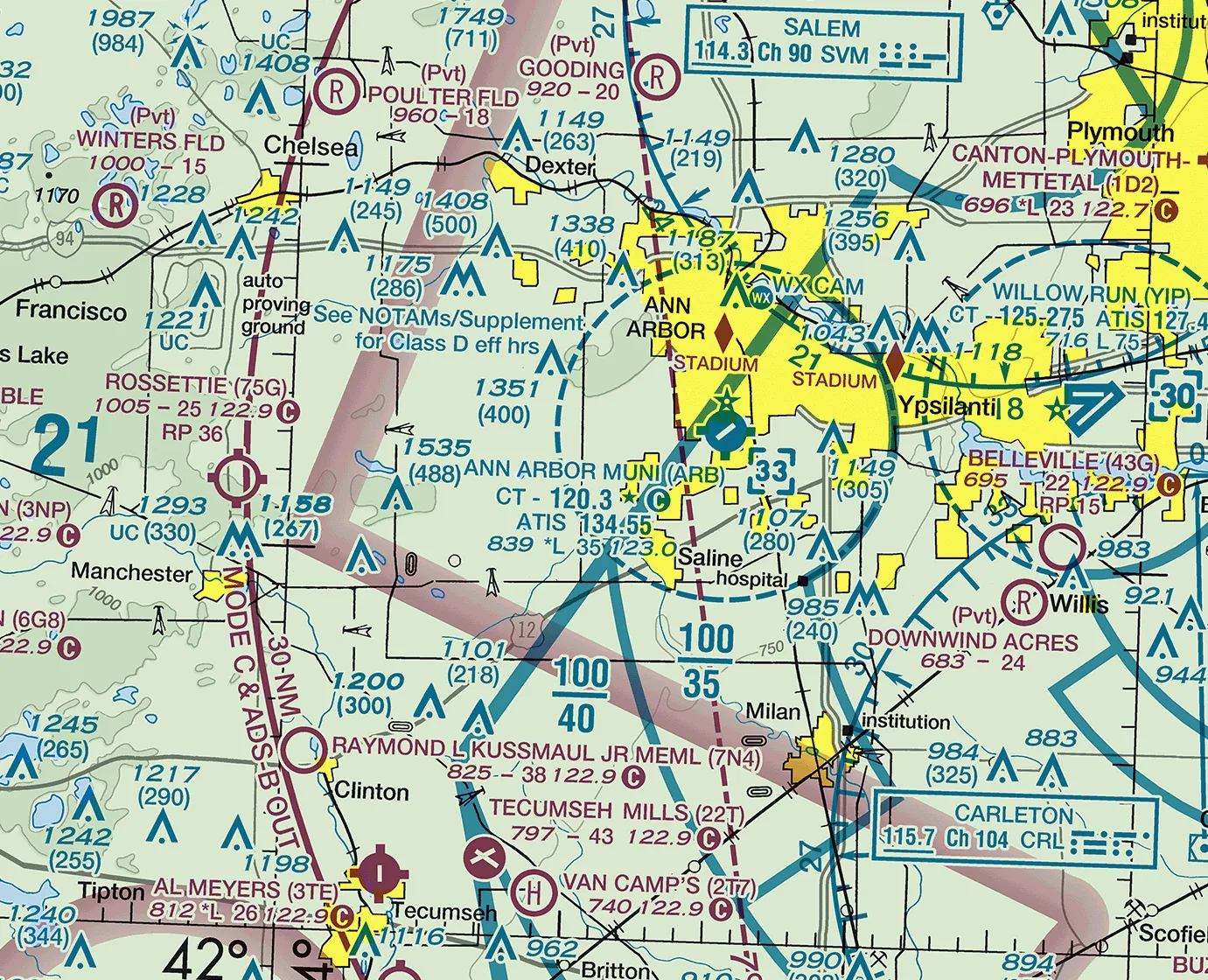
FAA Detroit sectional, 29 OCT 2026 edition. For briefing, not for navigation: fly from the current chart. Tap the chart to open it full size.
Today's flight
Someday, on a humid July afternoon, you are flying home from a grass-field breakfast like Brooklyn with a friend beside you. The haze has thickened since the morning, the clouds are lower than forecast, and one by one the landmarks and then the horizon fade into the same grey. You did everything right on the ground, and the sky changed anyway. It could happen on the trip you named in lesson 2.
This lesson is how you get out of that alive: keep the airplane right side up on the instruments, even with one of them failed, turn around or find better air, use the GPS or a VOR to point you to safety, and ask ATC for help early. We fly it over four or five flights, about 45 minutes under a view-limiting device each time while I watch for traffic, until these hours add up to the 3 hours of instrument training the checkride needs.
Every flight
Before every flight
P
Pilot.Am I fit to fly today? IMSAFE:
Illness
Medication
Stress
Alcohol
Fatigue
Emotion, and eating
A
Aircraft.Is this airplane ready, and right for today? Documents, inspections and open squawks; fuel and oil on board; weight, balance and performance for today's load.
V
Environment.What will today's flight meet? NWKRAFT, what 14 CFR 91.103 asks you to know before every flight, then the airspace and the route:
NOTAMs and TFRs
Weather, against your minimums
Known ATC delays
Runway lengths
Alternates
Fuel required, with reserve
Takeoff and landing distances
Airspace: the Class B limits from the current chart
The trip: heading, time, landmarks, wind and runway
E
External pressures.What is pushing me to go today: a passenger, a schedule, a plan I don't want to cancel? Would I go without it?
If it goes wrong.The takeoff emergency brief, out loud: an engine problem on the runway, after liftoff with runway left, and after liftoff without.
Who flies.Who does what today, and how we hand the controls back and forth.
Who runs it today:You, unprompted. You brief me as your passenger, and I listen.
Deeper today:Pilot and Weather. Pilot: how well you slept, ate and drank matters more under the hood, because fatigue, dehydration and a cold all make it harder; a cold is also a reason not to fly at all. In winter, Aircraft too: check the carbon monoxide detector. Weather: read the visibility and ceilings in the reports and the forecast for the whole afternoon, and say at what visibility you would turn back if this were a real trip, not a training flight.
Recall
From earlier lessons
Before a short-field takeoff, how do you know the runway is long enough?
Reveal answer
From the handbook's takeoff chart for today's pressure altitude, temperature and weight, with every correction in the notes, plus your own margin.
Under the hood in lesson 8, what did your inner ear tell you that wasn't true?
Reveal answer
That a slow turn felt level, or a level roll-out felt like a turn. The instruments were right.
Your friend's bag goes in the back and the CG ends up aft of the limit. What does that do, and what do you do?
Reveal answer
The airplane is less stable and a stall is harder to recover from. Move the weight forward or leave something behind, then work it again.
What is a turn-back trigger, and when do you set it?
Reveal answer
Something you can see that tells you to turn around, like a ceiling or visibility you won't fly below. You set it on the ground, before departure.
WhyYour sense of balance only works with your eyes; take away the horizon and it will lie to you within a minute.
Why the horizon matters
Your inner ear senses changes in motion, not a steady turn. A slow bank can feel level.
Spatial disorientation: your body says one thing, the airplane does another. It kills pilots.
Trust the instruments from the moment the outside goes, before you feel confused.
Haze is sneaky: you can see down through it but not ahead, so the horizon goes first.
WhyYour body is an instrument too, and several things in the air can quietly make it read wrong.
Your body and the air
Hypoxia: too little oxygen. It feels fine while your judgment slips. At night your eyes feel it lower down.
Hyperventilation: fast breathing under stress, tingling and lightheaded. Slow down and talk.
Ear or sinus block: don't fly with a cold. Descending is when it hurts.
Scuba diving: wait before you fly. The AIM gives the hours.
WhyIn a Michigan winter the cabin heat is air warmed around the exhaust, and a crack lets the exhaust in.
Carbon monoxide
You can't see it, and you may not smell it. Headache, drowsiness, dizziness.
Check the CO detector on every winter preflight, and glance at it in flight.
Suspect it: heat off, fresh air vents open, and land.
Symptoms that stay after landing: get checked by a doctor.
WhyA long hot day under the hood is when small things in your body become big ones.
Heat, water and a queasy stomach
Drink before you're thirsty. Headache and tiredness come first.
Motion sickness: fresh air, eyes outside, smooth flying. Under the hood, say so and we stop.
Pills for motion sickness can make you drowsy. Ask before you take any to fly.
WhyNo single instrument tells you everything, so your eyes keep moving in a pattern.
The scan
Attitude indicator in the middle: it shows pitch and bank. Start every glance there.
Out to one instrument and back: airspeed, altimeter, heading, turn coordinator, vertical speed.
If the attitude says level, the altimeter and heading should agree. If not, one is wrong.
Small changes, then trim: set the attitude, let it settle, trim, check.
WhyThese four are the whole escape: hold it level, turn around, and climb or descend to better air.
Straight, level, climbs, descents and turns
Straight and level: hold the attitude, check the altimeter and heading, correct gently.
Climbs and descents: the handbook's normal power and attitude, then trim.
Turns: standard rate on the turn coordinator, and lead the rollout a little.
The 180: a gentle, level, standard-rate turn back to the good weather is usually the way out.
WhyEach instrument has its own way of being wrong, and you need to know them before one fails.
When an instrument lies
The heading indicator drifts. Set it to the compass about every 15 minutes, in level flight.
The compass is wrong in turns and when you speed up or slow down. Read it straight and level.
The vertical speed lags a few seconds. Use it for the trend, the altimeter for the number.
A blocked pitot tube or static port makes the airspeed, altimeter or vertical speed lie.
Your handbook says what to do: pitot heat if you have it, or the alternate static source.
WhyIf the vacuum pump quits, the attitude indicator and heading indicator die slowly, and a dying one is worse than a dead one.
Partial panel
The warning: a low suction reading, or a slow, quiet drift in pitch or heading.
Cover the failed instruments so they can't fool you.
Bank from the turn coordinator. Pitch from the altimeter, vertical speed and airspeed.
Heading from the compass: small, slow turns, and read it level.
WhyIf you were distracted or disoriented, you may look up to an airplane that is nose high and slow or nose low and fast.
Unusual attitudes
First read the attitude indicator and the airspeed: nose high and slowing, or nose low and speeding up?
Nose high, slowing: add power, lower the nose, level the wings.
Nose low, speeding up: power off, wings level first, then raise the nose gently.
Then settle: level flight, trim, and a heading toward better weather.
WhyIn haze the airplane's navigation radios and the GPS can find an airport you can't see.
Pointing to safety
GPS: "nearest airport", then "direct to" gives you a course. Fly it as a heading.
VOR: tune it, check the Morse code, and turn the knob until the needle centers with a TO flag.
Fly the attitude first, then the needle.
Tell ATC where you're heading.
WhyATC can see you on radar and knows where the weather is better; a call early is cheap, a call late may be too late.
Getting help
Flight following means a controller already knows you. Tell them what you see.
Say it plainly: where you are, VFR and not instrument rated, the weather, and what you want.
If you can't stay in VFR conditions, declare an emergency.
A way out in good weather is better than being vectored into cloud.
A real accident
On January 12, 2001, a private pilot without an instrument rating took off at night in a Cessna 172K from Terre Haute, Indiana, for Greenwood, with a passenger. Indianapolis Approach told him the weather ahead was a quarter mile visibility in freezing fog with a 100 ft ceiling, and said "I'm not sure you want to come this direction." The pilot said he would divert, and the controller pointed out an airport about six miles ahead. The radar track kept heading east into the fog, there were no more transmissions, and the airplane crashed into trees, killing both people on board. The NTSB found the causes were the decision not to fly to the alternate, continued flight into known bad weather, spatial disorientation and loss of control. The help was offered and the plan was said out loud; it had to be flown, early, while the pilot could still see. NTSB report CHI01FA064
Your calls
Decision points
When the visibility drops, I will ask you to call it: turn around, climb, descend or ask ATC. You pick, and say why.
Whether a climb is safe: are you sure you will stay clear of cloud, and of the Class B shelf above you?
What to tell ATC, and when. I may play the controller and ask questions you have to answer while you fly.
An instrument disagrees with the others: which one do you believe, and what do you cover?
After an unusual attitude, which way is better weather, and how you get there.
The whole flight
Also on this flight
Part of the flight
Who
Every-flight routine and navigation log
You, unprompted; you brief me
Preflight, start, taxi, runup, takeoff
You
Departure under the Class B edge to the practice area
You
Flying under the view-limiting device, about 45 minutes
You
Watching for traffic while you are under the hood
Instructor
Turns to headings and 180s: at least four each flight, to standard twice in a row
You
Unusual attitudes: at least two nose high and two nose low each flight
Instructor to set up; you recover
Partial panel, from the second flight on: a 180 and a heading to an airport
You; I cover the instruments
GPS or VOR to the nearest good airport
You
Radio calls to ATC, real and role-played
You
A simulated failure after the hood work: unannounced after solo, briefed before
Instructor to set up; you handle it
Back to KARB, pattern and landing
You
Logging the instrument training
Instructor
Debrief
Both, you first
The standard
Ready to move on when
You hold altitude, heading and airspeed under the hood, and fly climbs, descents and turns to headings. By the checkride the ACS asks for altitude within 200 ft, heading within 20 degrees and airspeed within 10 knots (tasks VIII.A to VIII.D, Private Pilot ACS).
You recover from nose-high and nose-low attitudes promptly, in the right order, without overstressing or stalling the airplane, with a full panel and with a partial one.
You fly a 180 degree turn back on instruments, partial panel included, and say where you are going.
You can name each instrument's errors and what a vacuum, pitot or static failure looks like.
You can say the signs of hypoxia, hyperventilation and carbon monoxide, and what you do for each.
You use the GPS or a VOR to find the nearest good airport, and make a clear call for help to ATC.
Your logbook shows the 3 hours of instrument training required by 14 CFR 61.109(a)(3), over as many flights as it takes.
At home, before the next flight
Chair fly it
Next is planning the dual cross-country to Battle Creek (KBTL). Start it now; it's due before lesson 17. Read the dead reckoning and flight planning sections of the navigation chapter (16) and the reports and forecasts sections of the weather services chapter (13) of the Pilot's Handbook of Aeronautical Knowledge.
Find KBTL in the Chart Supplement and on the sectional. Bring a list of what you'd need to know before landing there.
Chair fly the escape: horizon gone, eyes to the attitude indicator, wings level, a gentle 180, and your call to ATC said out loud.
After the flight
Debrief
You go first, then the instructor. Three points at most, and you write down one thing to work on next time.
Your first 180 on instruments alone: which moment did you most want to look outside, and what kept your eyes in?
Which part of your scan did you skip when you got busy?
If this had been real, at what point would you have turned around, and was that early enough?
Before the flight
Four or five flights, each with about 45 minutes under the hood; make the first one 30 minutes. Tired students learn bad scans.
Brief the hood work and the unusual attitudes before each flight: how you will set them up, how you will hand the controls over, and that the student can take the hood off any time.
Pick a day with good visibility for the training itself. Brief the haze as the scenario; don't fly in it.
Remind the student that hood work at the practice area is still under limits: no climbs into the Class B shelf near KARB, from the current chart.
Aeromedical facts are in AIM 8-1: hypoxia (8-1-2), hyperventilation (8-1-3), carbon monoxide from cabin heaters (8-1-4: suspect it with exhaust smell, headache, drowsiness or dizziness; heater off, vents open), ear and sinus block, and scuba wait times (8-1-2: at least 12 hours after a dive with no decompression stops before flying up to 8,000 ft, 24 hours otherwise). Dehydration, heat and motion sickness are in the aeromedical factors chapter of the PHAK.
For the help call: AIM 6-2-1 (radar service for VFR aircraft in difficulty), and 7700 and 121.5 if not in contact with ATC (AIM 6-2-2 and 6-3).
If your airplane has electric attitude and heading (some 172s), teach the failure it can have instead, from its handbook. Partial panel is still covering the instruments.
In the air
You are the only one looking outside. Clear the area before each maneuver and keep the clearing turns going.
Common errors: fixating on one instrument, chasing the vertical speed, forgetting to trim, losing altitude in turns, overcontrolling, rolling out late, turning the wrong way on the compass, and pulling before leveling the wings in a nose-low recovery.
Set unusual attitudes gently and well above the ground. Have the student close their eyes and put their head down while you maneuver, then say "recover."
Role-play ATC: ask the student where they are, what they see and what they want, while they keep flying.
If it isn't working (the scan breaks down, or the student is getting queasy), take the hood off, fly visually for a few minutes, and end with one easy thing done well.
Curveballs
After solo, some may be unannounced, in safe conditions only; before solo, brief them all.
Unannounced after solo: cover the attitude indicator mid-turn ("vacuum failure").
Unannounced after solo: "the CO detector just changed color." The student runs the steps out loud.
Briefed: play Detroit Approach and ask for a heading and altitude that would take them toward cloud, and see whether they say "unable."
Briefed: "the GPS just went blank," so the VOR is the way home.
Briefed: a nose-low spiral while the student is busy with the radio.
After the flight
Mark the first: the first 180 on instruments without help.
Log each hood session as instrument training toward 61.109(a)(3), with the maneuvers flown. Keep a running total.
Ask what the student would do if the haze came on their own solo cross-country, and write the answer into their personal minimums.
Note which maneuvers still need work for the next hood session.